 |
In 2013, I've upgraded the server side each.co.uk system aspx / c# to "serverless" and "nameless" ≈360KB javascript combinable with webassembly without plugins, 3rd party, CSS..
minimizing iterations*per functionality to maximize reuse, with ideas partially presented at conferences in Santorini, Adelaide, Geneva, Daejon and virtually at IS4SI 2021 Summit
● Linguistic principle of arbitrariness of the sign 1916
● Information Theory 1940s
● Multi layer logic of the chess composition 1928 + Model of Inteligence 1998
* iterations fragment functionality. Eg. Achilles can't overtake the slower tortoise:
as he moves closer, she moves a bit further, so he moves closer and closer to never reach her.
The higher fragmentation in various layers (server, JS, css, sql, frameworks..),
the more unproductive interations..
|
"Serverless" runs the all codes in a browser JS, wasm.. except inevitable basic save, send.. data
operations run in a few server's commands sql, php, c#, py...
The server's functionality is ended, no modifications needed.
The old system's outages or users' cut-offs were unresolvable
in the server admins installed server's load-balancer to vanish
when server's operations moved to the browser.
It also absorbed the code in Vanilla JS, simplifying the logic.
The split code C = S server + B browser
multiplies the cases: S*B 2 layers > S+B 1 layer.
If the code is equally split in server and client: S=B, the code a moved from the server: S-a, to the browser: B+a (B=S),
decreases the cases by ≈ a2:
(S-a)*(S+a) ≈ S2-a2.
The ended server's code: S≈1 prevents bugs on the server,
while 2-layers' code S>1, B>1 multiplies the bug's occurence (S*B): a2.
The higher code's concentration in fewer layers,
the less cases and the higher reuse reducing the code itself.
Usually there are 5 layers: ● server script ● database/SQL ● javascript ● CSS ● html.
Number of cases N is: 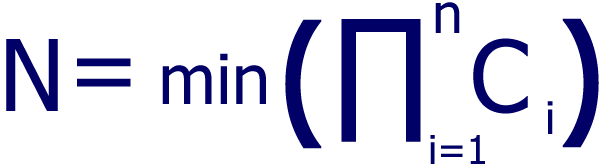 ,
where Ci = cases in layer ni, and C1+C2+..Cn ≈ C.
For C1≈C2..≈Cn≈C/n, the code only in 1 layer has n*C/n*1*1.. = C cases, while the code in n layers has (C/n)*(C/n)*(C/n).. i.e.
(C/n)n cases.
Clearly: C < (C/n)n. Eg. 50 cases in 1 layer is 50, while in 5 layers 10 per layer it's 105 = 100,000. ,
where Ci = cases in layer ni, and C1+C2+..Cn ≈ C.
For C1≈C2..≈Cn≈C/n, the code only in 1 layer has n*C/n*1*1.. = C cases, while the code in n layers has (C/n)*(C/n)*(C/n).. i.e.
(C/n)n cases.
Clearly: C < (C/n)n. Eg. 50 cases in 1 layer is 50, while in 5 layers 10 per layer it's 105 = 100,000.
|
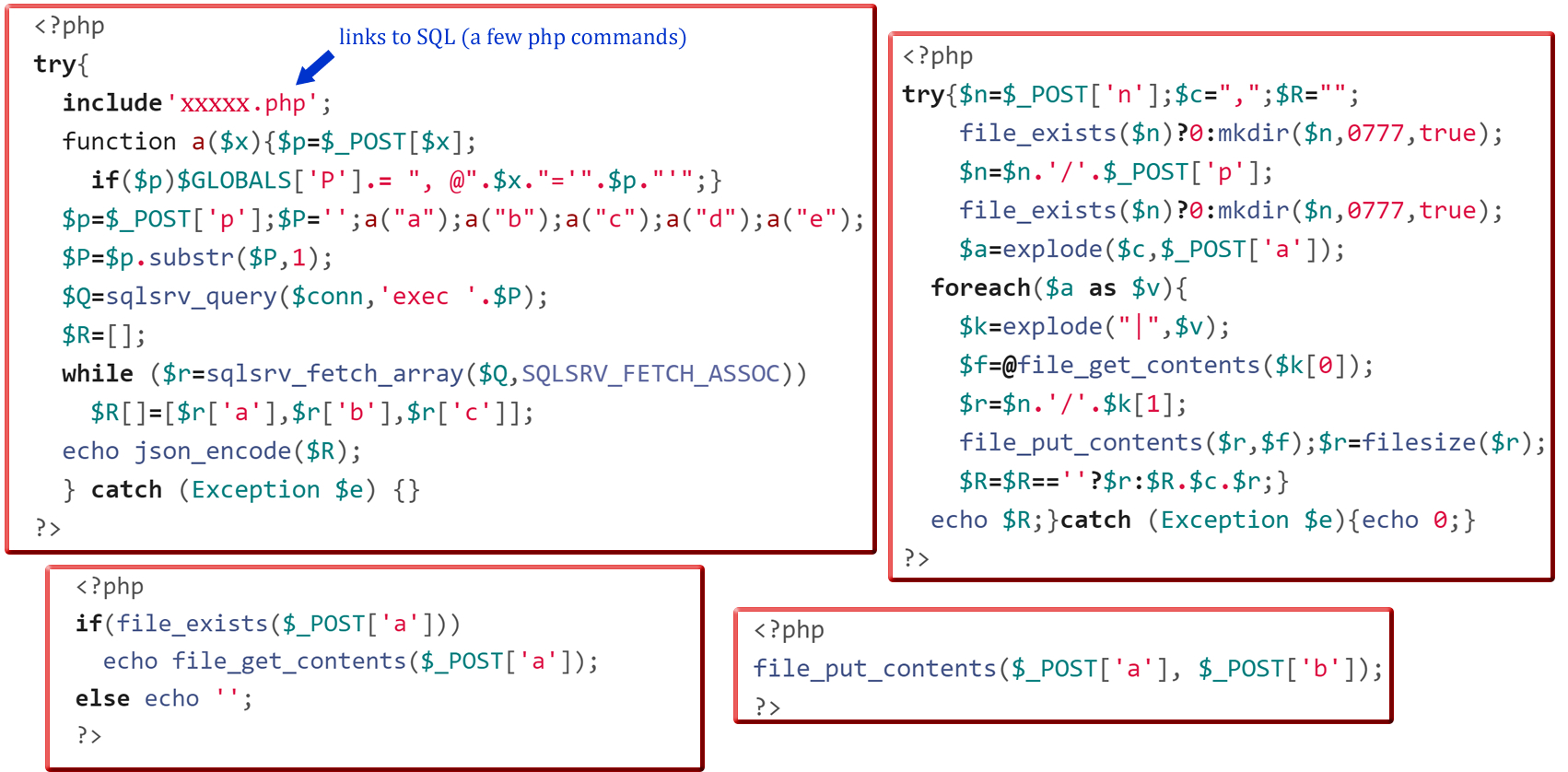
Examples of tiny php files: easy to change to any script: py, pl, c#..
|
Data and bitwise logic
Ideally data are reused and compressed to minimize the bytes to store and transmit.
Data files use the server less than SQL / DB, but for the matches or data mix SQL is useful.
I removed or merged all SQL (procedures, meta-data, indexes..). E.g. the javascript date-time replaced the SQL identity key.
E.g. 17. Oct 2022 09:01:33
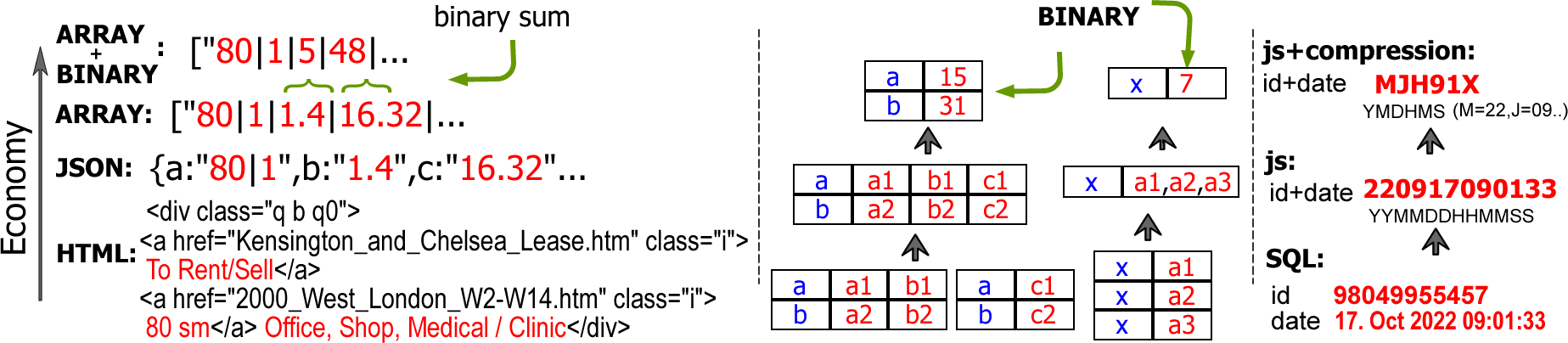
⇒ YYMMDDHHMMSS ⇒ 220917090133 compresible to YMDHMS ⇒ MJH91X (M=22,J=09..).
The different users can add the property exactly at the same time, so the properties' ids could collide.
To avoid this, the agent's id YMDHMS can be added to the property's id YMDHMS: YMDHMSYMDHMS - 100% unique key in javascript without SQL / server.
In the old system, each attribute (property size, property pics, property rent..) had own table to be joined
to load the items. E.g. property had 24 sub-tables. It was slowing down the server.
I merged the all sub-tables to 1 table, removing the SQL keys. Only the main tables remained: Property, Requirement, Negotiator, Branch, Chat, etc.
Multiple values tenures, subtypes, counties.. merged to binary sums
or comma separated ids to replace intersection tables. Simple data forms json, array create html in JS, replacing the server's generated html.
The array seems ideal data form, as the same info in array:[5,7,2..] is smaller than in json:{"a":5,"b":7,"c":2..} with min 1-letter key (incl apostrophes + colon)
adding 4 bytes per key. E.g. 10 properties with 30 attributes load at least (10*30*4) 2.8 KB more from DB if they load jsons instead of arrays.
The bitwise operators can compress and detect multiple values.
To utilize the binary sums, every value must follow series: 2 x, x∈{0, 1, 2.., n}.
So the values of attribute can be: 1, 2, 4, 8, 16 etc..
Eg. for tenures: lease=1, short lease=2, freehold=4, long lease=8.
Then if the property is lease (=1) and freehold (4), its tenure is (1+4) 5.
Or the requirement for freehold (4) and long lease (8), has tenure 12.
Then the bitwise "&" detects if eg. Property's tenure (X) matches the Requirement's tenure (Y): X&Y>0.
In our example 5&12=4 - they match. This is much faster than detecting the match in strings '1,4' vs '4,8'.
SQL server limits binary to 2^31-1 B, so there can be max 30 multiple values in one column.
In our database there are over 100 subtypes, so we have 3 columns of binary for Properties' subtypes: X 1, X 2, X 3, and 3 columns for Requirements' subytpes: Y 1, Y 2, Y 3..
And the matches are determined by X 1&Y 1>0 or X 2&Y 2>0 or X 3&Y 3>0. The binary value is calculated in javascript when property / requirement is created or edited.
Also because we keep the order of displayed subtypes we still store comma separated subytpes' ids.
|
Data form compression
|
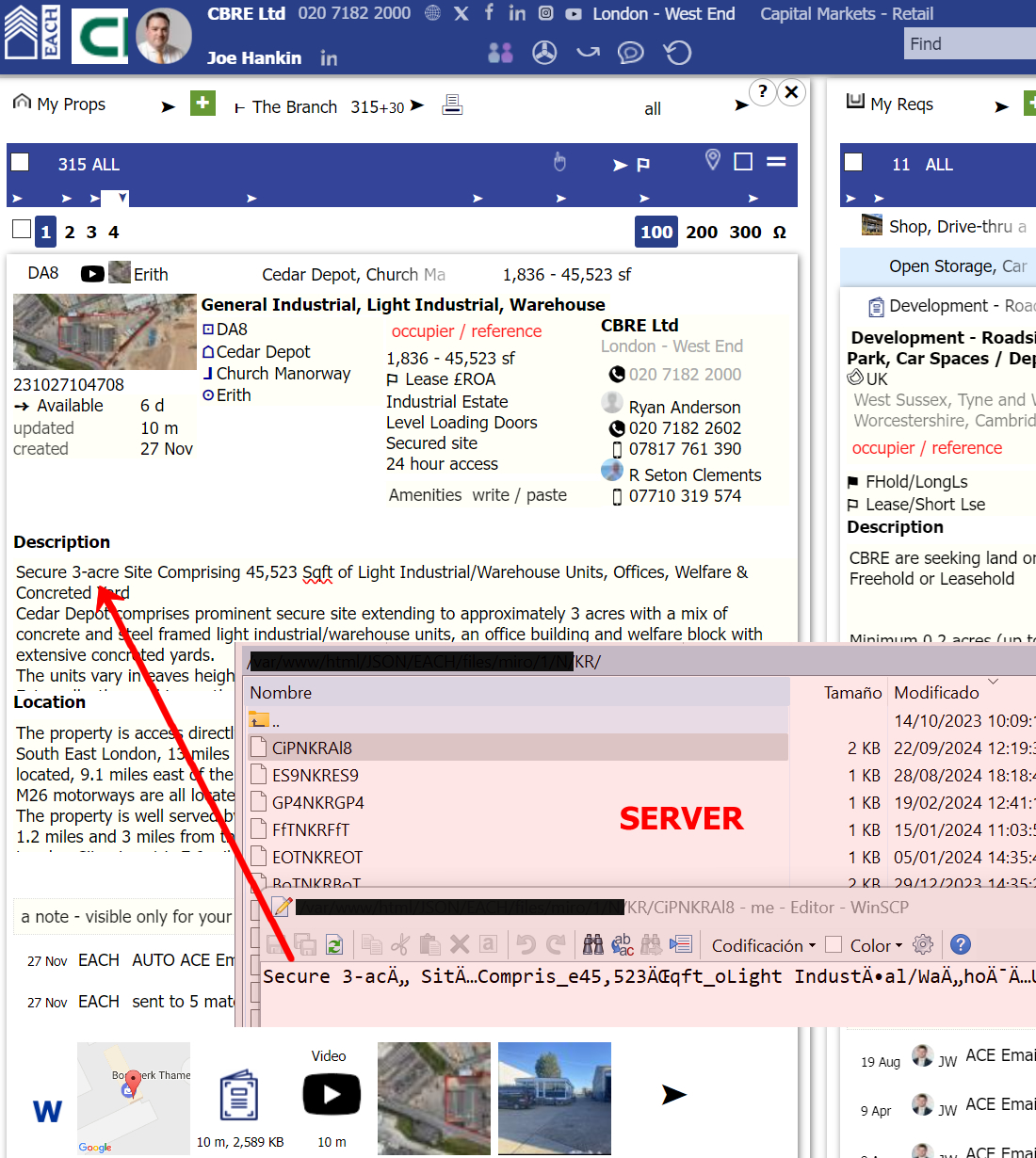
The long texts as descriptions are
compressed using keywords replacements or lossless, Huffman algorithm in JS before saving. Js also decompresses
the file, loaded only if needed:
eg. the description is loaded only as the line/grid view is clicked to show detail.
If the text is needed in the keywords' search, the texts can be saved
also in the reduced but uncompressed form: without repeated words,
in the SQL used only for the keyword's search - the text itself always loads from the compressed file.
All replaceable SQL was removed.
Eg. as the Property was created, its county id was assigned (based on postcode) from the 4 MB SQL table of 32K rows,
which slowed down the server.
I replaced it by a simple 52 KB files' system with
4 postcodes' letters to get the county / council id by JS.
|
|
|
Tiny postcode's file with county / council id

|
Text from the compressed file in the detail view
|
|
|
Uniform data form & ajax / fetch
| |
In 2002-2013, each.co.uk used over 30 aspxs' pages: properties.aspx,
requirements.aspx, invoices.aspx, department.aspx..
with specific SQL procedures. The url
had to reload to view the pages keeping server's user session.
AJAX (asynchronous javascript + XML) arose in 1999 (fetch in 2015), enabling single-page app (SPA) to load data without re-loading the url.
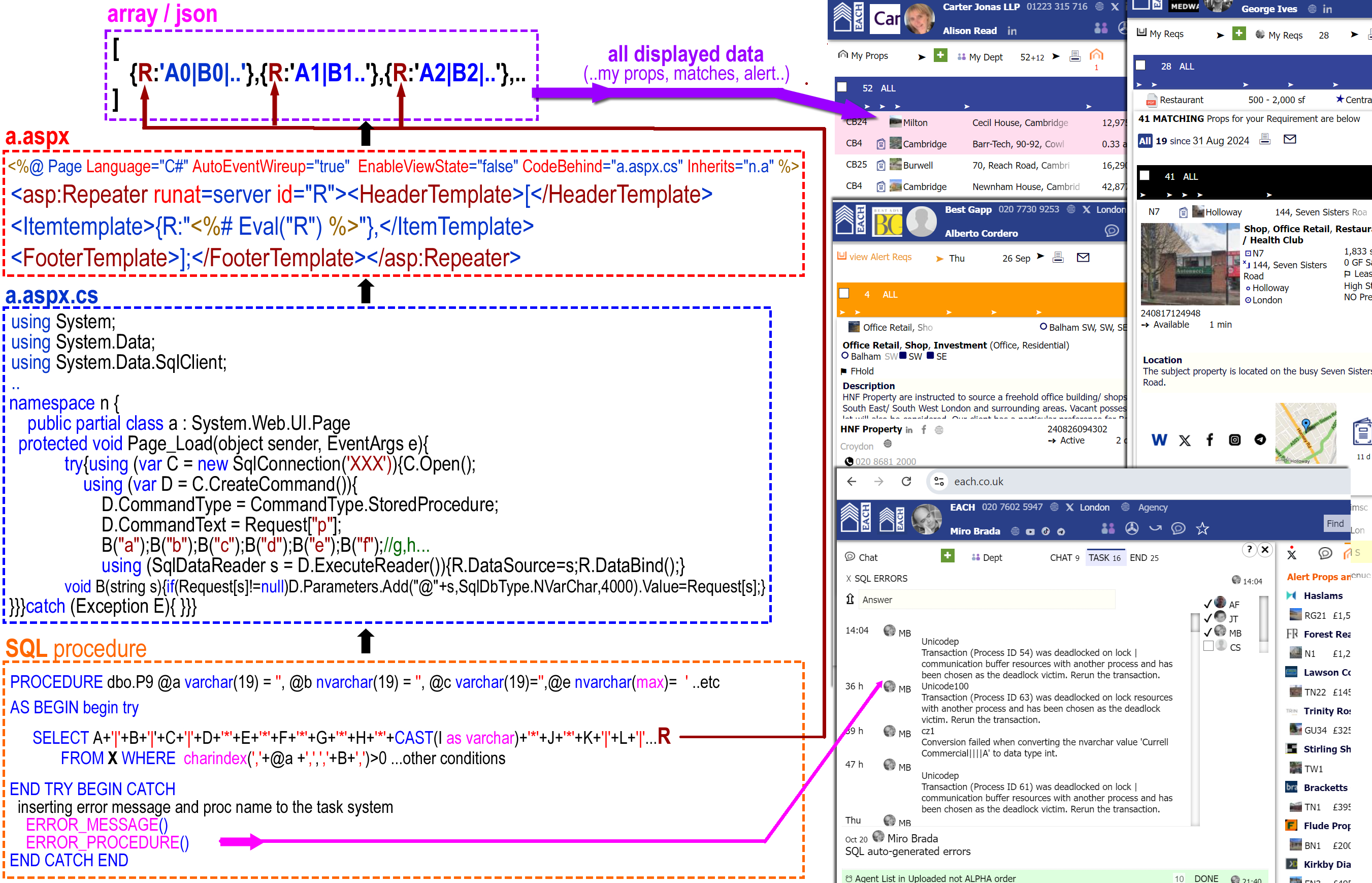
Using ajax, I merged the all aspxs to one aspx loading
single parameter 'R' uniting the 'SELECT' of all SQL procs
with uniform data form:[{R:'A0|B0|'},{R:'A1|B1|'},..].
I reduced the aspx / c# code to tiny C# scripts. In 2019 I rewrote them to php in 2 days.
And I replaced jsons by arrays: [['A0|B0..'],['A1|B1..'],..] to reduce the size of loaded data.
SQL ⇒ C# ⇒ aspx ⇒ json mechanism to load all data
|
Security and deployment
|
"Serverless" system without 3rd party programs and plugins, has fewer options to be attacked.
The only vulnerability resides in running JS in Inspect Element / console.
To obfuscate the code is helpful, but not an obstacle for an experienced hacker.
Also deleting the header's references is right, so if the page is downloaded, there is no JS file.
But the IE console shows the JS functions as 1st letter is typed - so the functions from the JS deleted files can be revealed.
The main protection seems to disable IE via keycodes / right mouse click, and replace the codes as the IE console opens.
Further, to insert / update data, the hash from the server is required.
Parts of the code can be in webassembly whose compiled binary hides the code.
This is just a brief explanation without details.
The old system used MS Visual Studio for development with source safe.
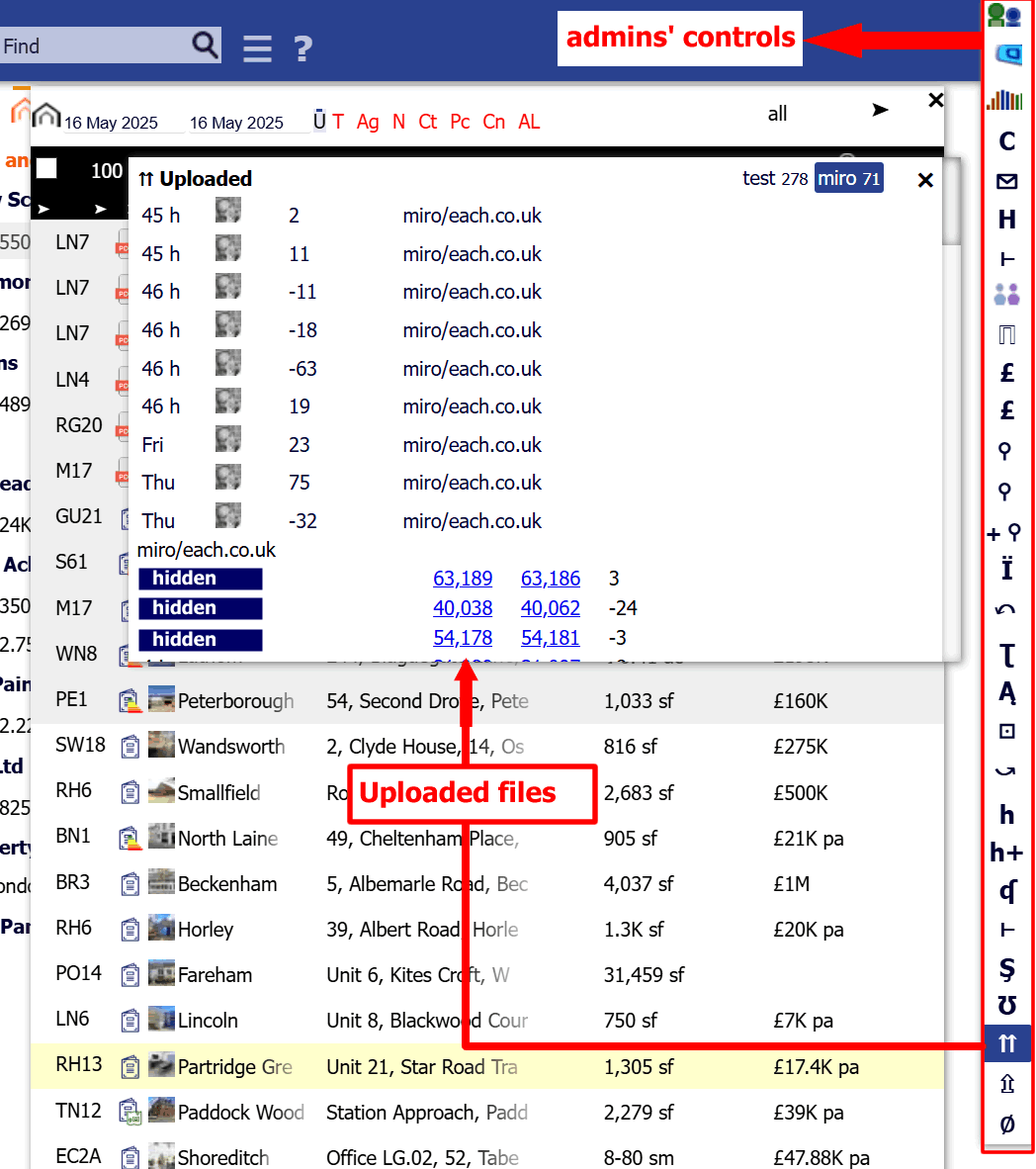
I removed it to develop a tiny ⇫ deployer as Admin control to open and select files to be deployed at the folder specified in the input box the last value is default.
Mostly JS files are deployed, but any file including server's php, images or wasm can be deployed.
It also auto-backs up the files replaced by the new ones.
⇈ Uploaded stats shows the deployed and old files, size change, who and when deployed, and option to view the files.
For a team-work, every programmer has own JS file to write his code (functionality).
To define the global function / variable - Admin's ∅ uniquer shows a free 2-letter name - unused by any global function / variable.
3rd party programs, plugins, frameworks increase vulnerability.
No surprise, there've been regular and serious outages of renowned companies eg. TSB bank, Barclays, British Airways, Mark & Spencers..
A brief view of their websites' sources, reveals many codes & plugins on their front-pages (after search / login more files are loaded).
The foreign codes are uncontrollable and so decrease security, performance and compatibility.
Except each.co.uk I developed the public site 4prop.com to
capture enquries from searches or SEO pages.
The emails enquiries have gradually in 2 years increased from 0 to 45 a day.
Each.co.uk's deployer was deploying the 4prop's files and other
companies' websites with each.co.uk's JS search.
In Sep 2014, a new programmer against my advices and will,
replaced 4prop.com by codes using many plugins.
It destroyed the SEO enquiries, and increased the dependency on the 3rd party.
The admin in Jun 2020 installed 'docker' unneeded for each.co.uk,
but needed by new 4prop to deploy the codes.
Each.co.uk and 4prop.com used separate DB (each.co.uk DB
was copied at night to 4prop DB), but both had access to the files.
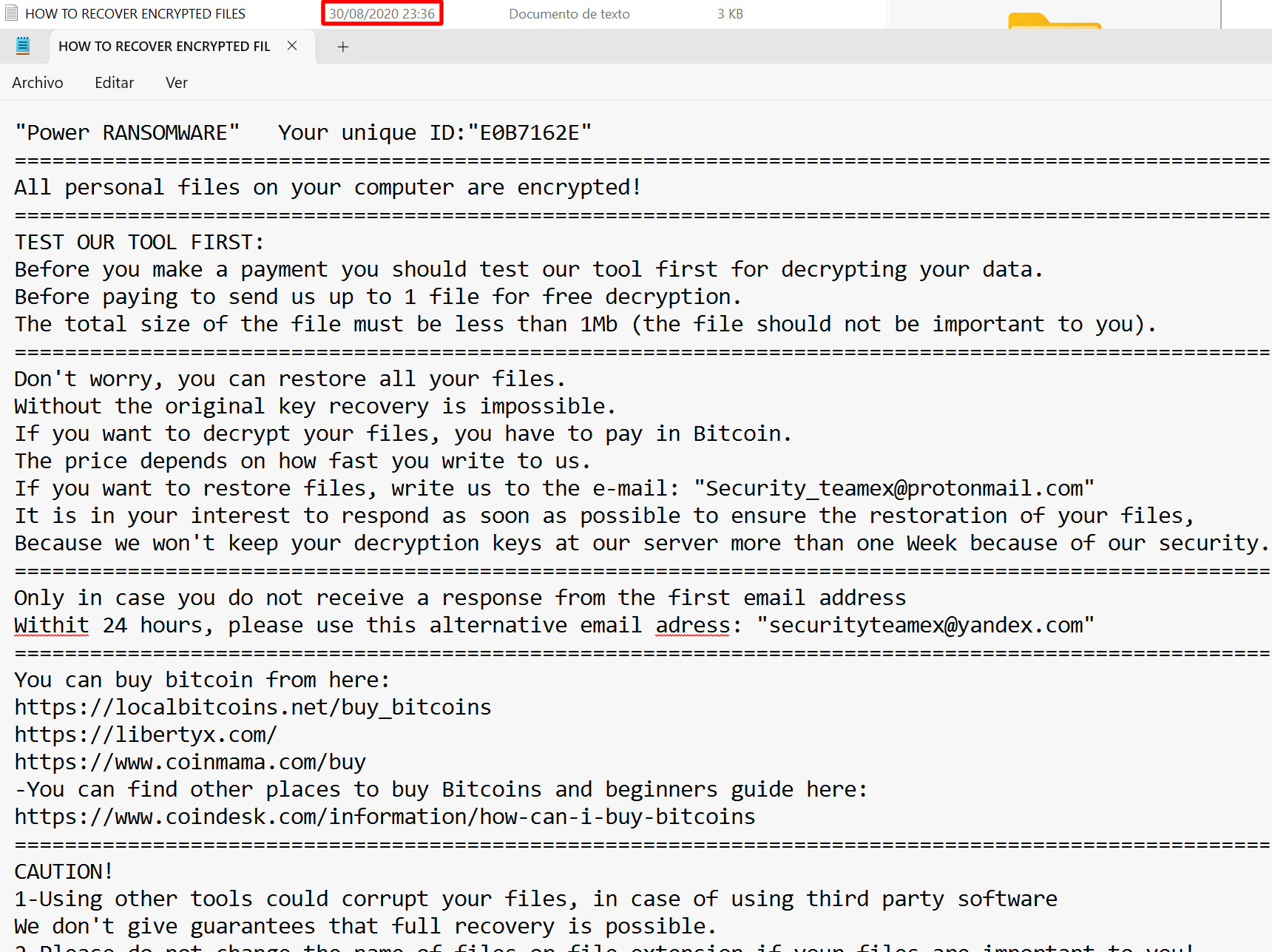
On Friday 28 Aug 2020, the hacker via 'docker' started encrypting the attachments and pics.
Marcel - other programmer, noticed it on Sat night; almost all files had been ecnrypted.
I stopped the server. On Mon our admin retrieved the backed up files before the attack.
Mon was bank holiday - if unnoticed, the backed up files could be encrypted too.
So we almost lost data, only because of wrong decision I couldn't affect.
|
Admin's Deployer

| Admin's Deployer's statistics
|
|
Ransomware attack on Fri 28. Aug 2020, from the 3rd party "Docker" used by 4prop.com (not each.co.uk)
|
|
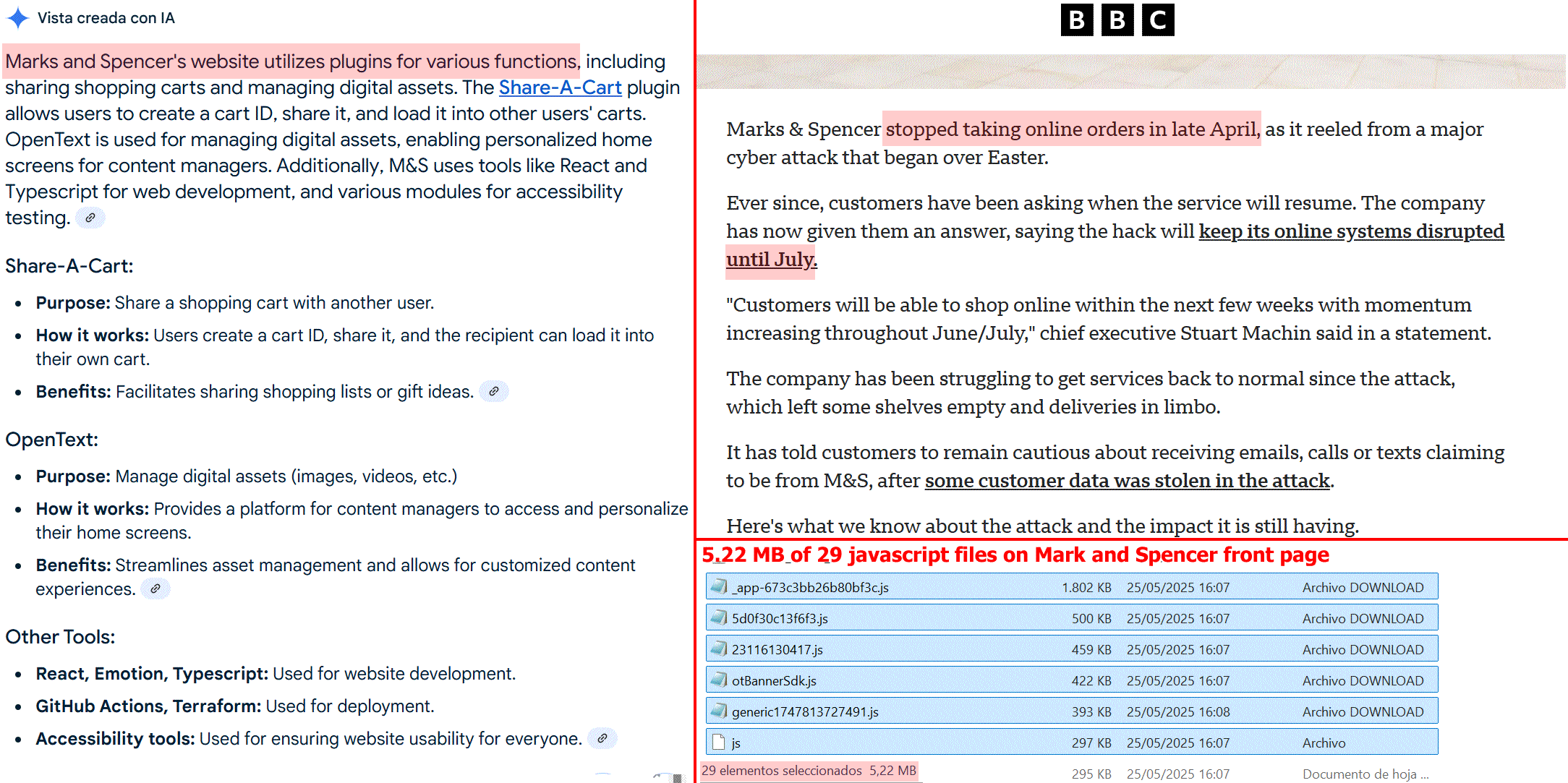
On 21 May 2025, BBC informed that Mark & Spencers hasn't taken order since end of April and the disruption will be until July!
Downloading the M&S's website shows 5.22 MB of 29 JS files only on their front page, while the biggest JS file has 1.8 MB!
The AI names long lists of various plugins or programms utilized by M&S website..
|
Mark and Spencer 21 May 2025.
The front page: 5.25 MB's JS with many foreign JS limiting the reuse & security
"Nameless" Information
"Nameless" merges the layers CSS, html, sql with own names to single layer
JS to reduce the names definitions running the system.
In 2017, I presented my lecture Psychological and other aspects of the sign arbitrariness
at the conference in Geneva The Arbitrariness of the Sign, an idea (1916) of linguist F. Saussure:
the word signifier and its representation what signifies is arbitrary.
Names' Reuse
Complex logic eg. language, reuses its units. European languages have c. 30 letters whose combinations create all meanings.
Abstract characters: "a", "b".. are easily reusable,
unlike chinese pictographs: 2-3000 needed to read the newspaper.
Because non-reusable characters disable grammar, the chinese has 'radicals': reuseable 'arbitrary' units amending the meaning of the pictograms.
Eg. a 'radical' denoting a person: 人 rén or its shorter form: 亻
is added to other characters. Everyone: 人人 rénrén, estimate: 估 gū, imitate: 仿 fǎng, night: 夜 yè.
● The more abstract units, the higher reuse.
● The smaller reuse, the harder to construct a logic.
Chinese characters even with radicals aren't abstract enough for advanced grammar.
It's very simple: no tense, verbs don't change..
Except 'radicals' the chinese uses 'measure' words
adding extra specifications to compensate simple grammar.
They are added before nouns: 个 gè is more general, and other more specific as: 只 zhī to count animals or single items in pairs, 张 zhāng for flat things: table, paper, pic.., 碗 wǎn for bowls..
● The simpler grammar, the higher divergence of logic.
The chinese-similar languages Mandarine, Cantonese, Japanese, Koreans, Vietnamese..
differ a lot more
than european languages eg. Slavic Slovak, Polish, Russian..
or Latin Spanish, Italian, Romanian...
As "Deaf and dumb language" sign language
with 'shown signs' uneasy to reuse,
isn't universal, with own distinct versions across countries / regions.
Names' reduction
Long names prolong the code, while real names as 'save', 'property', 'date'..
creates an illusion of understanding.
The real name is as one-use 'pictogram' without variations.
Eg. chinese 'home' 家 jia is 'pig under roof',
but it could be: 'cow under roof', 'head under roof'.. and/or 'pig in a room', 'pig next window'..
Or if 'pig under roof' is home, what's 'pig under tree'?
A cottage? No, a cottage is 小屋 xiǎowū - small house..
This shows countless variants for the same thing. The real name pictogram can be a perfect hint,
but in more contexts it confuses / misleads.
In 2018, I applied 1-2 letters' abstract names for functions, variables, tables, columns, SQL procs.
I did a function to find free 2 letters for unique name undefined in JS.
The set for the 1st letter are 26 [a-z] letters or [A-Z] capitals or underscore _: 26+26+1=53.
The 2nd letter can include 10 digits [0-9], i.e: 53+10 = 63 possible signs.
It's: 53*63=3,339 unique 2-letters' names.
On 1 June 2025 each.co.uk used 2,546 76% names for complex functionality emails, chat, invoices, views, users, properties, requirments, companies, alert, filters, archive, searches, import, prints, ETL, SEO etc.
The names repeat at least 2x, but often several times.
If 2,564 names would have on average 3-letters, it's: 1*2,564*2=5.128 KB extra.
For 4-letters repeating 4x, it's 2*2,564*4=20.512 KB extra.
The code was reduced by 50+ KB, as the names often exceeded 4 letters and 4 iterations.
Shortening the names doesn't reduce the names.
Their reduction results from moving CSS, HTML and SQL structures to JS.
In 1994, Håkon Wium Lie introduced CSS to define the styles. It splits the code needing an extra name: class or attribute,
while CSS is definable "namelessly" in JS whose names style's constants can be endlessly reused.
So for the same style, JS needs far less names and bytes of code than CSS.
To illustrate: CSS can name widths as [bX]{width:Xpx}.. [b0]{width:0px}[b10]{width:10px}[b35]{width:35px}..
Each "Xpx" width has own name "bX".
In contrast, mere 4 JS names constants
eg. Sy, fh, pX, wQ can define any width:
const Sy=' style="'
,fh='width:',pX='px"'
,wQ=Sy+fh.
Then: CSS [b0]{width:0px} [b10]{width:10px}
is equivalent to JS wQ+0+pX, wQ+10+pX..
CSS name is longer and each value has own name.
For {0,1,..,9}px widths: CSS name has 15 letters - while JS 7, for {10,11,..,99}px widths: CSS name has 17 letters - JS 8..
For 100 unique {0,1..,99}px widths:
CSS has 100 names and 1,682 KB 10*15+89*17+1*19 B,
and JS has 4 names and 0.836 KB 10*7+89*8+1*9+45 B (for JS names), so JS has 96% less names and 50.3% smaller code..
The more code, the bigger difference.
|
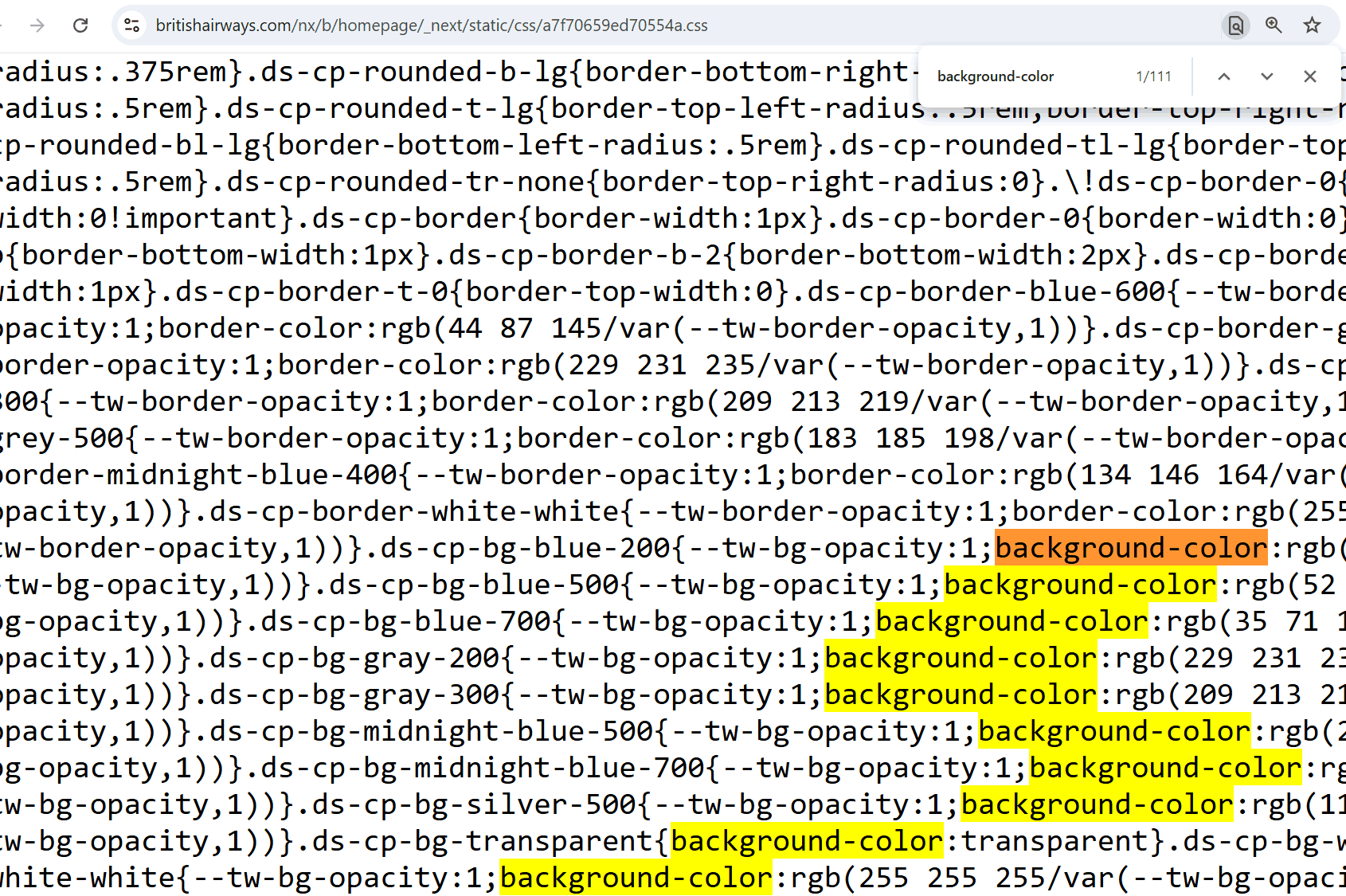
10 June 2025, 491 KB CSS file on British Airways's website
|
CSS styles height, color, background, opacity, padding, position,
radius.. are often variously combined in CSS attribute or class,
further expanding the names, while JS combining styles's
names namelessly.
CSS can define just one name for each attribute color height with.. to combine names in HTML with multiple names eg: div element '<div class="ab cd ef">' links 3 classes: .ab, .cd, .ef
instead of one class combining styles. One attribute and value per CSS name increases name's reuse, but in practice the multiple styles in CSS name is common.
One of the British Airways's CSS file has eg. 16 letters' background-color attribute, often combined with other attributes, in 111 classes.
If background-color is defined as 2 letters' JS constant, it would save 14*111=1.554 KB.
|
Replacing multiple styles would further reduce over 110 names
and more bytes - just for one
CSS name.
Reducing (by 2 letters'
JS constants) 4 other attributes eg.
line-height 9x82=738,
font-size 7x64=660,
padding-bottom 12x55=660,
margin-bottom 13x47=611 would remove 2.669 KB.
So moving merely 5
CSS names to
JS would reduce 4.233 KB
and 354 names.
CSS values as
1000px,
transparent,
sans-serif,
relative.. can be also defined as
JS constants to further reduce bytes..
Eg. in British Airways'
CSS, there is 6x 37 letters' value
rgb(52 104 173/var(--tw-bg-opacity,1) = 222 B (in 2 letters'
JS 12 B).
Or 28x 11 letters'
transparent = 308 B (in 2 letters'
JS 56 B).. Defining style's values as
JS names reduce the bytes but increase the number of names.
So it's rational to use
JS names for style's values, if they repeat many times.
HTML app's skeleton
used to be in the files
templates filled by data on the server.
Since ajax / fetch enabled to load data asynchronously,
the html has been more often created in the browser,
although the html files are still common to create emails, SEOs, reports
pdf, doc...
But,
HTML is also definable by
JS names, eg:
const _i=
'<div '
,
_P=
'<span ',
D1=
'</div>'
,
s8=
'</span>'
HTML in the file with full style:
<div style="width:10px"></div>
Or with the style in the separated
CSS files:
<div class=b10></div> + .
b10{width:
10px}
Or:
<div b10></div> + [
b10]{width:
10px}
By
JS names, it's the incomparable shortest:
m_+
10+
Yj,
where:
m_=
_i+
wQ,
P8=
'>',
y9=
pX+
P8,
Yj=
y9+
D1
The combined
JS names create any
HTML of any style for website, emails, SEO, reports..
to hugely reduce the structure / code / cases..
JS auto-job runs in the browser (as EACH Admin logs in),
fetching files / DB's data, to make emails, import / export / checks..
7 Admins used to login - sufficient to run the
JS auto-jobs.
Later I added the auto-jobs to be run by all users' sessions - a tiny (1%) fraction of random users.
JS auto-jobs aren't intensive and can't cause any browser's outage.
"Just-in-time" control
file flag prevents running the same auto-job mutiple times in different browsers.
On the server, there is mere 1 job: a tiny
php file
sending
1 simple loop (no data processing)
the emails whose html / data were created in
JS.
Emails are created / sent: 1) as the item
property, requirement.. is created / edited,
2) by user's action
ACE / Message/Enquiry, 3) by
JS auto-job.
Eg.
daily Alert emails items n
1, n
2..
max 3 properties and 3 requirements per email
to M users: N*M, while the same item n
x is sent to multiple users.
The old system called c. 7 SQL functions
to get: address / location, types, size, tenure, amenities, descriptions, agents for every single n
x item to be created, while the Nameless system creates the n
x only in
JS with no SQL call.
Each.co.uk sends c.
40K+ various emails a day:
2x ACE: Prop / Req, 2x Matches: Prop / Req, 2x Alert immediate: Prop / Req, 2x Register Check: Prop / Req, Alert daily/weekly, Tasks / Chats, Enquiries.
C. 5-10K are
daily Alert email - we can assume 7.5K with 3 items
of max 6 on average per email: 7.5K*3*7 = 157.5K SQL calls, in contrast with 0 calls by the nameless system.
Other emails have 1 item per email, except
Matches that can contain more items.
Overall, we can assume 1.5 item per email: 40K*1.5*7=420K SQL calls per day to create emails by the old system.
The SQL calls queried 1 or more joined tables - as the old system had fragmented DB's structure.
And the Matches and Alert matches used the intensive string's id searches instead of binary sums.
So regular SQL / server outages occured.
|
Except reducing the server's SQL overload,
JS reuses itself to remove
the duplicated SQL functions that sharply increase maintenance costs and probability of bugs,
as modifications or new functionality had to be in JS as well as SQL, and in the old system in C#/ASPX too.
One programmer used to re-compile SQL for emails / reports to mimic the JS change.
The emails or htm pages (as SEO) can use template with css styles (instead of longer nameless inline style) to reduce the size of email sent from the server.
Unlike web browser with the constructed style from the 2-letters JS names, the emails' browser cannot make their style dynamically from JS names.
So althouth the emails are namelessly created by JS, the html email must contain the full style:
<div style="width:10px"></div>, not nameless style:
m_+10+Yj.
Here it's shorter to use html template with css.
But the emails' browser as gmail, yahoo, outlook.. differ from each other more than the web browsers.
Especially outlook can show css differently.
And so a bit bigger emails' size using inline styles
can be compensated by the more consistent look in the different emails' browsers.
Overall, it's better to
|
2 KB of data of the Alert immediate email sent to 360 agents
 |
minimize the emails' html structure and inline styles to create emails namelessly.
Or to slighly enhance
JS functions to use css's classes for emails / htm pages.
To sum up,
JS names universally increase the reuse of the code, to radically reduce the costs of development and (server's) performance.
Another option to dynamically create HTML, style and functionality is
JS DOM
Document Object Model, which is however more complicated and less reusable with more specific commands / names.
And except extra load for the browser, DOM commands can become obsolete or incompatible in different browsers.
Plugins "imitate" calculus
Since 2000, various
JS plugins
libraries / tools / frameworks have appeared to hasten the development.
WordPress 2003
Matt Mullenweg, Mike Little,
Dojo 2004
Alex Russell,
jQuery 2006
John Resig,
node.JS 2009
Ryan Dahl,
Bootstrap (Twitter) 2010
Mark Otto, Jacob Thornton,
Angular (Google) 2010
Miško Hevery
,
React (Facebook) 2013
Jordan Walke
,
Vue.JS 2014
Evan You..
Many sometimes contradictory views claim why to use or avoid the plugins, or which one is better..
The plugin is a meta or super language with extra namespace to manage
usually JS commands.
It increases the size, reduces flexibility and speed, can corrupt security,
needs to be updated..
The advantage is pre-built functionality or auto-adjustments for mobile, PC..
It seems powerful and cool as to say 'be light' to be light.. But unlike calculus it doesn't bring the new quality, because the plain
JS can do all what plugins do.
Calculus is more than the set of calculations, it sums and combines the lower calculations
to capture the infinite series to exactly calculate eg. the globe's space.
Most likely there is only one way to define calculus, invented independently by Leibniz
1673 and
Newton 1665.
None of the plugins defines the universal logic to combine commands to the new quality.
Moreover, the plugins aren't to be understood, but to "free" programmers from the "lower calculations" to focus on the functionality.
But can be functionality well developed without understanding the underlying algorithms?
Seemingly, it's as surgeons don't need to understand their tools
microscope, scalpel..
to operate.
But the surgeons can't manufacture their tools themselves, while
programmers can replace any plugin by
JS,
except specific features eg. google map plugin with huge data of images, positions.
For programmers, the surgeons' tools are hardware (PC, laptop) not plugins that are only a method of work.
So, the plugin itself isn't such a big "magic wand" as it looks, while it's "a pig in a poke"
without a proper control.
"1-layer" systems
Corporations
at the West, in China / elsewhere can be different own many or most programming jobs, with a specific motivation
to use multi-layers frameworks / plugins prioritizing control and monopolization over efficiency.
As a result, the job-market often prefers the plugins' experience. It forms programmers' motivation
and opinions leading to 'fan-clubs' of endless self-confirming views. It creates a self-fulfilling prophecy: the plugins / frameworks seem inevitable to standardize functionality with a support, community, knowledge-base.
It seemingly lowers the dependency on the individual skills, so the programmers
are easier replaceable to reduce the company's risk.
But in practice it's not so stunning, as mentioned failures of IT frameworks' systems:
Mark & Spencer,
BA,
TSB..
Plugins' 'fun-clubs' would say: it would happen or be worse without plugins..
Also it's uneasy for companies to find programmers to build up the pluginless system,
which can be intention of the IT corporations to prevent competition.
To ditch the framework means to transfer the functionality that's often too expensive.
From animation, Holland Park, 2013
4 images of the series created in Flash Action Script
| But Netflix in 2017 replaced the React by JS in login & landing pages to significantly (50%) improve the performace.
Or in 2024 Microsfot abandoned React for its Edge browser development, due to inefficiency..
Moreover, the plugin can become obsolete.
Flash Adobe Player (1996) enabled advanced
including interactive animations in its Visual Studio / Action Script.
Flash's fla compiled to swf files were running in browsers' plugin.
In 2020, it stopped being supported due to a security vulnerability.
In 2003 I started using Flash for animations and app selling perfumes.
At that time, JS couldn't create such visual effects. Even today the HTML5 with canvas element (2005) can't do all what Flash could.
My acquaintance co-working on Flash projects, claimed the Flash is the best as it works in the all browsers, and those not using it are 'stupid'..
Earlier, the differences among the browsers were bigger than today (2025), and the Flash visuals were far superior to JS.
Later, JS has enabled advanced animations too, so Flash became less exclusive with unresolved security, resulting in its end, although
Flash's swf can still run in Ruffle Mike Welsh, 2016 as browser's extension.
|
In 2013, I applied
Flash for map's display and drawing area on each.co.uk, but shorlty after I replaced it by
JS.
Then, I was using
Flash only for animations
presented at my art exhibition "From Animation" in Holland Park
Oct 2013.
For 3D effects I used
Blender Ton Roosendaal, 1994 with
Python Guido van Rossum, 1980s, and
Videopad NCH Software, 2008.
The similar idea to
Flash is
Java James Gosling, 1991
with
JVM Java Virtual Machine
running on all server's platforms.
Flexibility is at the cost of lower performance / higher memory consumption.
Java has become faster, but its popularity has been falling, namely since 2020.
Unlike
Flash focused on presentation / games no data,
Java hasn't depreciated as many data apps (banks, telco..) use it.
So the language can survive not because it's efficient, but because it creates too many dependencies costly to replace.
Different example is
COBOL Grace Hopper
started in 1959, still used by 43% of banking systems
Reuters, 2017: powering 65+% of enterprise software and 70% of business transaction processing, incl 95% of ATM swipes.
It's not used for the new programs, but it persists not only because it's costly to replace
as Java,
but due to its operational efficiency with
"superior stability and processing power".
As
Google states, a motif to create
COBOL:
"the need for a universal business-oriented programming language to run on different computer systems, reduce development costs, and speed up business operations".
In fact,
COBOL runs in
1-layer - a crucial attribute of
serverless system.
To run on "server" or "browser" is irrelavant here, as data operations can't be always run in the browser.
The key thing is that the code isn't split in 2 or more layers.
Also the older languages as
Fortran John Backus 1953,
COBOL,
C Dennis Ritchie, 1972,
C++ Bjarne Stroustrup, 1979 had arisen before the internet (or ajax/fetch)..
They are efficient as they operate in
1-layer.
And, at those times, the efficiency was necessary as the computers
were far slower / inflexible, so the programs to work, had to be very economical.
Cheaper and faster computers reduced the necessity of 'super' efficiency
especially for web apps, while commercialization and outsourcing
since 1990s put the profit before the efficiency.
While the inefficient programs can suffice initially, as the complexity of processing raises, the maintaining costs
hugely rise with potentially unresolvable issues
costs, performance, security or other.
To sum up, the older systems as
Unix Ken Thompson, Dennis Ritchie, 1969 operate super efficiently
up to date as they arose from different motivations / environment than commercial apps as
Facebook Mark Zuckerberg, 2003,
Amazon Jeff Bezos, 1994 etc..
There are some exceptions as
Telegram Pavel & Nikolai Durov, 2013,
with the same functionality as Meta/Facebook,
but with far less resources
mere 304 employees, in contrast with Meta's 75K (2025).
Or
open-source Chinese AI
DeepSeek 2023, Liang Wenfeng
performed on par with
proprietary American
OpenAI 2015, for a fraction of a cost, resulting in Jan 2025, to the historical fall of the US stock market
chipmaker Nvidia: -18%.
The increasing proprietarization and monopolization controled by the 'market' - not quality control, oversimplifies IT products' assessment
creating biases and overexpectations such as a dot-com bubble in March 2000.
This mental outsourcing avoids understanding of the intricate ideas, while
still decides about their "market" value, to lower chances to recognize / promote the best ideas.
Quality of Algorithm
Descartes's
La Géométrie, 1637 with XY depiction of math, means: any visualization
incl. app is definable by one logic.
Newton in his
Philosophiæ Naturalis Principia Mathematica, 1687 elaborated the Descartes's idea unifying math and reality
its visualization to include his invention of calculus
1965.
So the new quality
Newton's laws roots in the unifying view of realities.
And the apps with various logic of
CSS SQL html JS php c# py..
prevent the higher efficiency of one logic.
All logics can't merge because:
● Unawareness of one logic's efficiency
● Short-term costs / risks of implementation
● Power structure not maximizing efficiency
If app works sufficiently well in separate layers
not one logic, it may be not worth to merge.
And because one logic requires the insight, skills as well as motivation, it's unlikely to prevail without enforcement.
Eg. why people don't speak one language, as it would be useful?
Colonial languages often replaced the indigenous ones, as language of the 'masters' was an advantage.
The language reform in China
1956, 1st Character Simplification Scheme, Turkey
1932-1982, Korea
1933, Unified Orthography, Vietnam
1910-1945
or Arabic language reform
The Nahda Period, Late 19th/Early 20th Century simplified and unified logic to increase literacy / intelligibility.
The differencies / specifics
slang, accent.. remain due to different regions, cultures, origins..,
but the same Spanish is understood in
Sevilla, Caracas, Miami.. as English in
NY, Singapore, Delhi.... Mandarine in
Kunming, Singapore, Taipei.. Russian in
Moscow, Almaty, Odesa..
Turing's machine
a-machine, 1936 is a metaphor of computer/CPU.
Wikipedia says: it "
manipulates symbols on a strip of tape according to a table of rules" to express any algorithm.
The app consists of algorithms of various loops
iterations assigning expected outputs for given inputs
a-machine, eg. ordering values.
Algorithms qualitatively differ eg. by their economies.
The less materials
chess pieces to construct the same idea in chess composition
algorithm, the higher its value.
It's the economy and it's generally true: the less iterations
energy to express the same idea, the higher its value
efficiency.
Like the shortest path connecting the same points: eg. route
Moscow-Beijing-Tokyo is shorter
more efficient than
Moscow-Tokyo-Beijing.
Algorithm's quality
Q relates to number of iterations
i per its functionality
f:
Q=f/i f>=i.
The iteration is the
series of the
same per unit of time.
The same iteration can express intricate as well as trivial thing.
Unpointed toes is a minus in gymnastics.
The pointed toe is
only 1 unique,
Pointed Toes, N=1
log2 N = 0 entropy
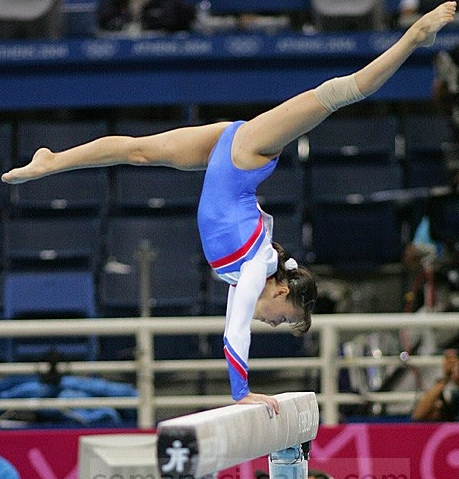
|
unlike many unpointed toes' positions:
∑ pointed toes ≪ ∑ unpointed toes.
The same flip is less likely uniquer with pointed than random toes =more possible iterations.
The lousy style lowers the performace's quality Q ↓ as it's divided by more iterations i ↑.
The high style as pointed toes, clean lines.. reduces the iterations i ↓ to increase the quality Q ↑.
In Shannon Entropy 1948, the reduction of the iteration in performance / functionality
minimizes the entropy: -∑ pi*log2 pi,
i ∈ (1,N), where N is a set of random positions in flip / performance.
The 'pointed toe' is only 1 and its probability is so 1. It gives: -1*log 2 1 = 0 entropy.
Any deviation from 'pointed toe' creates N > 1 states of probabilities < 1, with entropy > 0.
The random state Ni has probability 1/N for N states:
-N*1/N*log2 N-1 = log 2 N.
So the more random states N ↑, the higher entropy ⇒ i ↑ ⇒ Q ↓.
Many iterations decrease the quality, only if not utilized in more intricate peformace / functionality.
The more iterations per unit of time comparable to CPU's speed, the higher
potential usable in high intricacy Q ↑ or randomness Q ↓.
|
Reduction of iterations is called economy in chess composition.
As a beginner, I sometimes added unnecessary 'trap' pieces to mislead the solver.
I maximized the hardness to solve - a classic criterion in the chess composition
masterted by eg. Sam Loyd or puzzles.
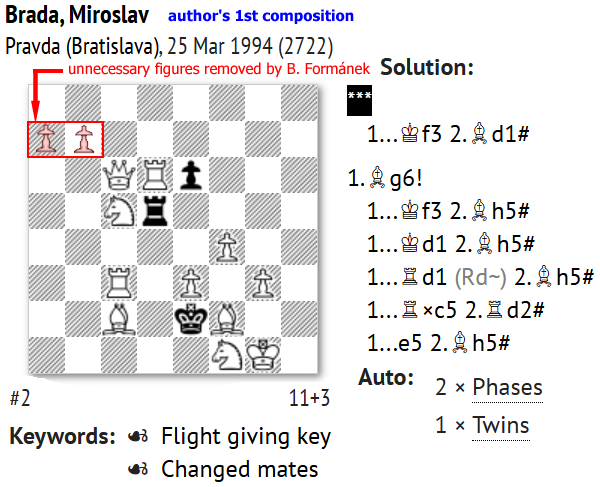
My 1st published composition intentionally hid the solution by:
● no threat: the mates after necessary move of the black
zugzwang
● the solution gives a free flight
● the same mate with distinct tying of the same black Rook
by white Queen & Rook
● extra 2 'trap' pawns on a7, b7 to mislead solvers
to waste their solving time
All is unexpected: the zugzwang is rarer than non-zugzwang, free flight is rarer too, the distinct tie in the repeated mate is very rare, and the 'trap' units can slightly confuse solvers.
I showed it
together with 30 other compositions in March 1994, at Bratislava's circle of chess composition.
About 12 present composers couldn't find the solution.
One used PC to uncover it.
Bedrich Formánek
president of FIDE for Chess Composition 1994-2002
removed 2 unnecessary pawns to publish the problem next week in Slovak daily
Pravda.
I was glad, but thought it was better with the 'trap' pawns that could mislead solvers.
Enhancing the options
N↑, makes the solution less probable
harder: 1/N.
The extra pieces enhance (+x) the options: N+x, to decrease solution's probability: 1/(N+x) < 1/N.
But the 'added value' of the extra options unrelated to the main mechanism, is negligible or detrimental.
In quality measure:
Q=
f/i, the extra pieces increase both iterations
i ↑ and functionality
f ↑ to mislead solvers.
If both equally grow:
Δf = Δi Δ=difference, quality
Q declines.
| In general, Q=(f+y)/(i+x), y=increase of functionality, x=increase of iterations.
For equally growing f and i: Δf=Δi=x ⇒ Q↓,
because: Δf=Δi=x, ΔQ=ΔQ/1=(Q+x)/(1+x)=((N-1)/(x+1))+1.
For lim x→∞, (N-1)/(x+1)=0, and so Qlim x→∞ = 1.
So for the quality not to decrease, the extra functionality Δf must increase more than the extra iteration Δi: Δf > Δi.
2 extra pawns don't add any special value to componsate the increase of iterations.
As a gymnast during a sault could wave or do something special it wouldn't add sufficient value to make a difference.
Instead if the energy iteration of 'waving' would be utilized in double sault or series of saults - it would add the higher quality.
So the app, design, composition or performance is better Q↑ without extra iterations i↑, unless they sufficiently enrich the functionality f↑↑: Δf > Δi.
| 
|
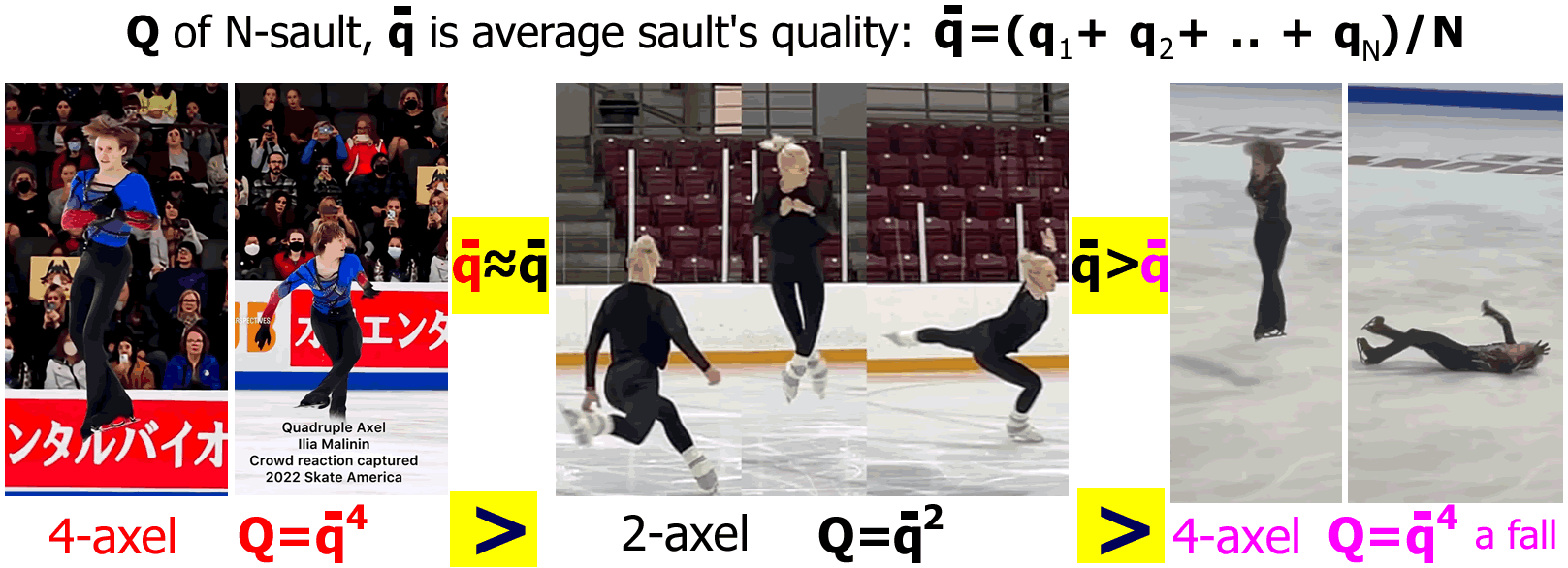
N-sault vs Nx saults: qN > N*q
It's easier to sault 2x saults or 1x double-sault?
Double-sault includes 1-sault, while some can be able to sault only 1-sault and not double sault.
So, N-sault is harder
rarer.. than N*1-saults.
If the sault's quality is
q, and the overall quality of
N saults is
Q(N) then
for
Q(N-sault) =
∏N q =
qN,
and for
Q(Nx saults) =
∑N q =
N*q
The flawless N-sault
no falls, pointed toes.. is always superior to Nx 1-saults:
qN >
N*q.
But any decrease of sault's average quality
q̅ ↓ changes the calculus.
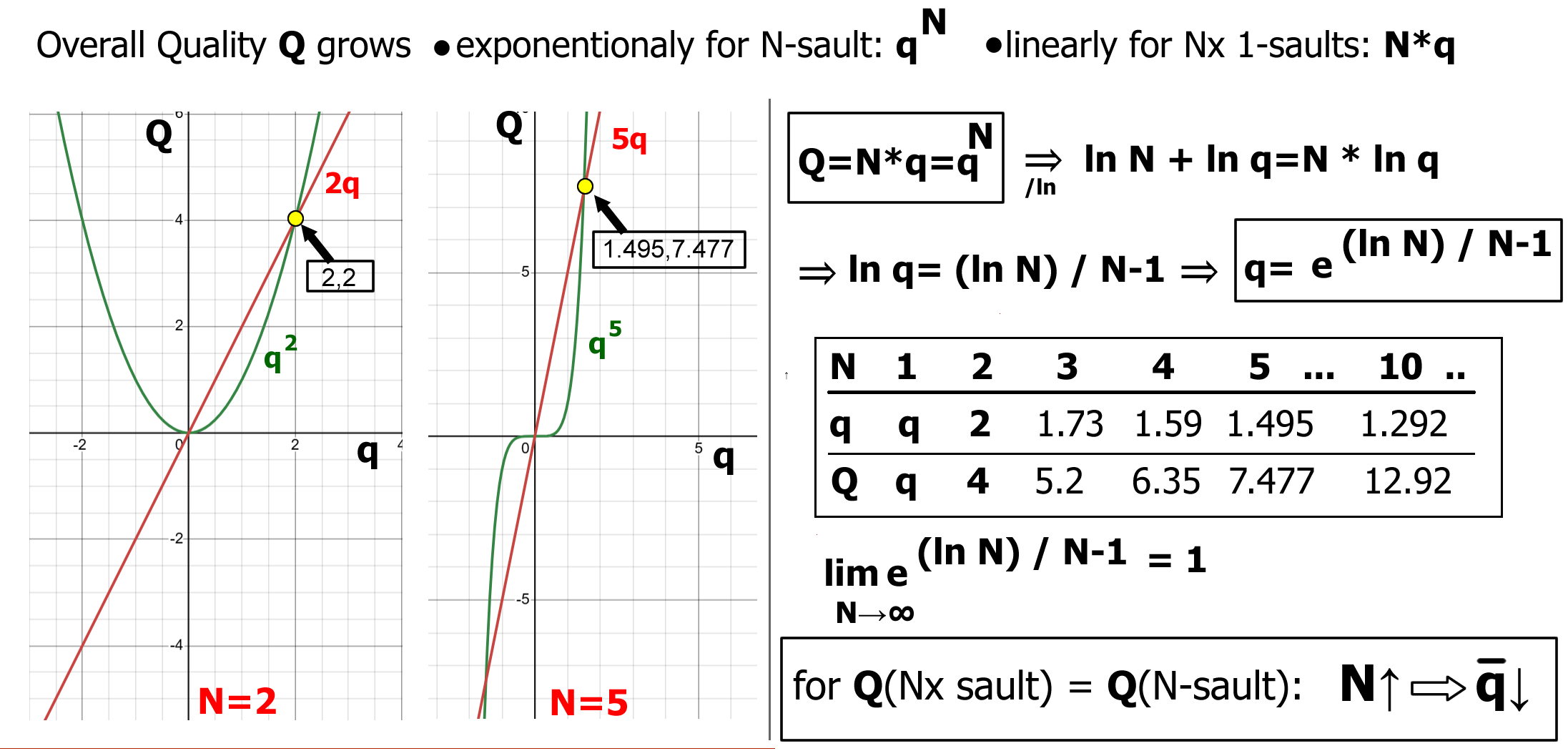
For
Q(N-sault) =
Q(Nx saults) ⇒
q =
e(ln N)/N-1 ⇒
q̅ ↓ as
N ↑.
For N=1, the q̅ and Q is identical.
For {N=2, q̅=2},{N=3, q̅=1.73},..,{N=10, q̅=1.292}..
Higher Order of Iterations: ∏N(∑n q̅)
The number of saults in N-sault:
q̅ N is Intricacy:
I ∈ {1, 2, 3, .., ∞}, which is higher order of iterations.
For Nx saults
I=1:
N*q̅ 1.
So N-sault and N*saults have the same formula:
Q(N) =
n*q̅ I, where
N =
n + I.
Or more generally
Q(N) =
∑n(∏I q̅). In a performance of a gymnast, acrobat or figure skater.. the
Quality is distributed in various and variously intricated saults/spins.
Eg. 4 saults can be distributed in ● 1 sault + triple saults ● 2x double saults ● 1x 4-sault..
Figure skating recognizes 6 types of jumps ordered by difficulty:
Salchow q1,
Toe Loop q2,
Loop q3,
Flip q4,
Lutz q5,
Axel q6,
when q
1 < q
2 < .. < q
6..
In 1999, Evgeni Plushenko landed 1st a series of:
Toe-Loop 4+
Toe-Loop 3+
Loop 2
=
Q(9) =
q24+
q23+
q32,
and in 2002:
Toe-Loop 4+
Toe-Loop 3+
Loop 3 =
Q(10) =
q24+
q23+
q33.
The real Quality must be divided by iterations (N) to
get the average
q̅uality per iteration:
q̅(N) =
Q(N)/N.
Otherwise many simple jumps, eg. 20x
q1, would exceed
Quality of eg. very intricate Quadruple
Axel =
q6 4 jumped only by Ilia Malinin in 2022.
Any series/sequences are comparable by the average
q̅uality eg:
●
q̅(4)=
q64/
4
●
q̅(8)=(
q63+
q53+
q12)/
8
●
q̅(9)=(
q23+
q23+
q33)/
9
.. etc.
The jump's frequency or its 1st date jumped could be used to calibrate its quality
q relative to other jumps.
Or number of falls per jump: the more falls, the harder the jump.
I didn't find online stats of the jumps' frequencies
in competitons per year, but there is stats of the 1st jumps
the later, the harder eg.
Axel 4 2022,
Flip 4 2016,
Lutz 3 2011,
Flip 3 1981,
Axel 3 1978,
Lutz 3 1962.., implying the hardest is
Axel then
Flip,
Lutz.
In Olympics 2002,
Flip had more falls than
Lutz, although the
Lutz is considered harder.
In our analysis, the figure skating is a useful metaphor and the exact calibration isn't needed.
The higher intricacy, the higher probability of the fall / imperfection:
I↑ ⇒
q̅↓.
A perfection is between 0 or 100%, so the redefined quality is:
q =
a*p,
p ∈
(0, 1),
p=perfection.
In N-sault both its value
a and its perfection
p increase exponentionally:
(a*p)N, while in Nx saults linearly:
N*a*p.
The imperfection
(1-p) in 1x sault doesn't influence another sault, while
any imperfection of the 1st sault of the N-sault propagates to the 2nd until the Nth sault.
The level of perfection
p remains the same for all N saults, while in N-sault it's: p
N, where
p <= 1.
So the N-sault's perfection is:
pN-1 times smaller than in N saults.
The mental acrobatics is physically unlimited with far more options.
In chess composition the 'sault' is as a change of mate, with enormous other options: change of defences, keys, motifs or paradoxes, hard to imagine in the figure skating.
Plus many other stipulations as Mate in 2, 3, .. N, or selfmate, helpmate, studies or numerous fairy definitions.
In Mate in 2 moves
#2, 2 moves
iterations of white lead to the mate to any 1 move
iteration of black defence.
These 2+1=3 moves
iterations can produce a trivial or very intricate composition.
Baghdad's caliph, Mutasim Billah created the oldest known chess problem at c. 840.
In Arabic empire, the chess composition was manṣūba
مَنصوب.
Difficulty to solve had been its main qualitative criterion
the harder, the better, until
Alberto Mari
l'Echiquier Belge in 1928 and Guido Cristoffanini
L'Italia Scacchistica in 1927
added the "neo-strategy" criterion
in the reciprocal
AB-BA change of mates:
the mates
A and
B to defences
a and
b in
phase 1,
interchange in
phase 2: so the
same mates
A and
B go to defences
b and
a.
It creates a new unprecedented quality that's a lot harder to construct than just to hide the solution.
Ľudovít Lačný made the 1st
ABC-BAC cycle in 1945,
and 4-fold
ABCD-DABC cycle in 1955.
The "neo-strategy" employs multiple qualities:
q1+
q2+..+
qn
in phase 1, multiplied by N phases:
Q=(
q1+
q2+..+
qn..)
N =
∏N(∑nq).
Or
Q=
∏Nn*q̅.
The intricater scheme
I↑ and more qualities
n↑, the less likely and later occurs.
The chess problem database
yacpdb.org
listed
June 2025 for all stipulations and definitions:
2,760
AB-BA, 402
ABC-BCA, and 30
ABCD-BCDA schemes..
The intricater, the rarer, June 2025
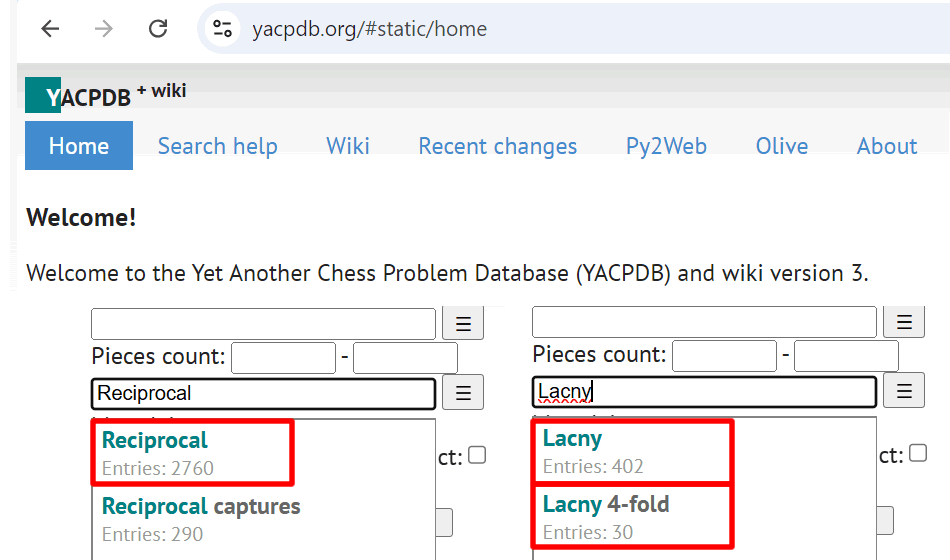
|
The reciprocal precedes the cyclic change
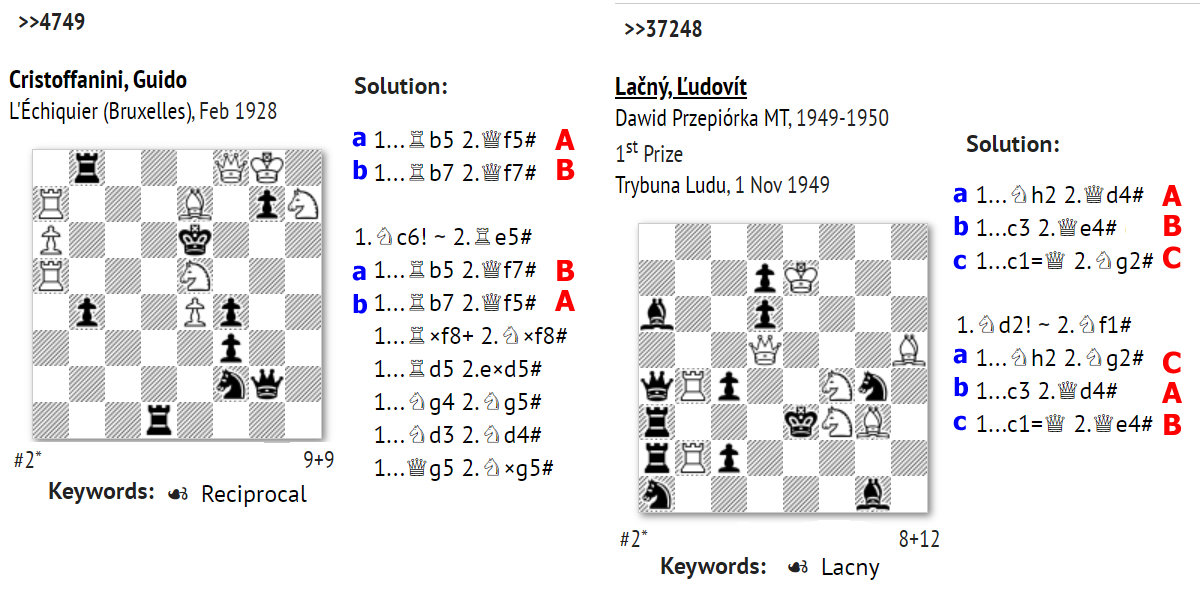
|
The formula
Q =
∏I(
n*q̅)=(
n*q̅)
I defines the qualities of all compositions
algorithms.
Eg: reciprocal
AB-BA:
(2q̅)(2q̅)=4q̅2,
Lacny
ABC-BCA:
(3q̅)(3q̅)=9q̅2, where
q̅ is the average mate's quality.
Mate
q̅, key
k, threat
t, motif
m or function
f can be variously changed / combined in the phases.
Any addition
within the iterations, without disruptions, increases the overall quality.
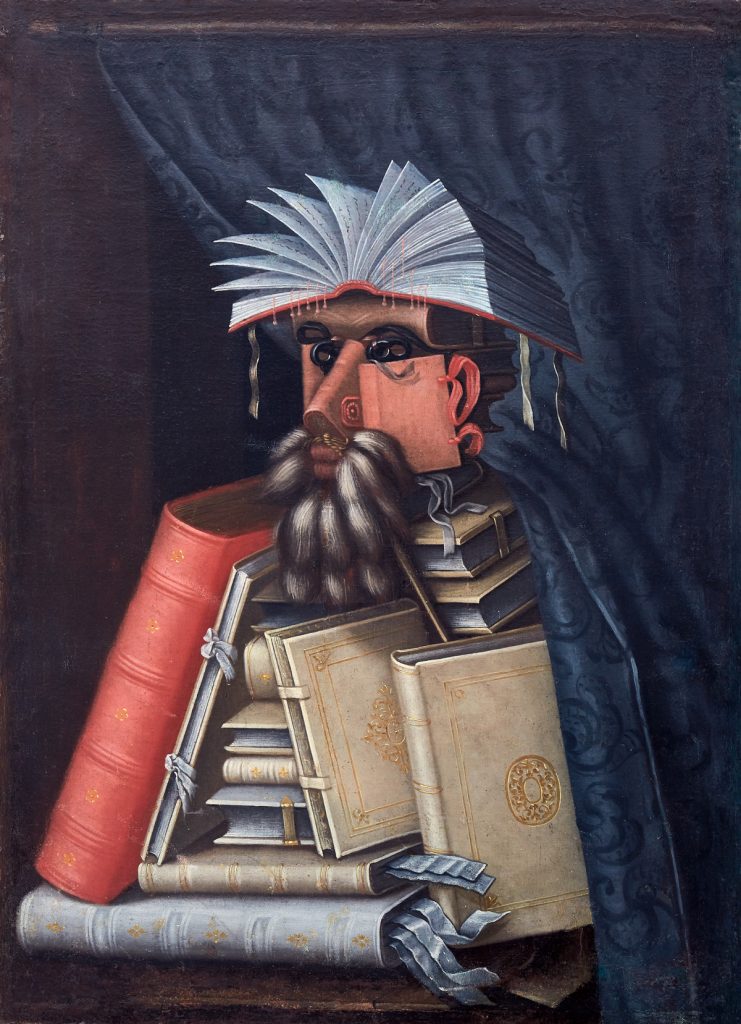
In my article
Chess Composition as an Art, I wrote
the Italians composers elaborated the
neo-strategy: '
a game in a game' recalling Mannerism
High Renaissance, 16C eg.
Arcimboldo's
collection of objects
=phase 1 creating other object
=phase 2 as
The Librarian 1566 from the books.
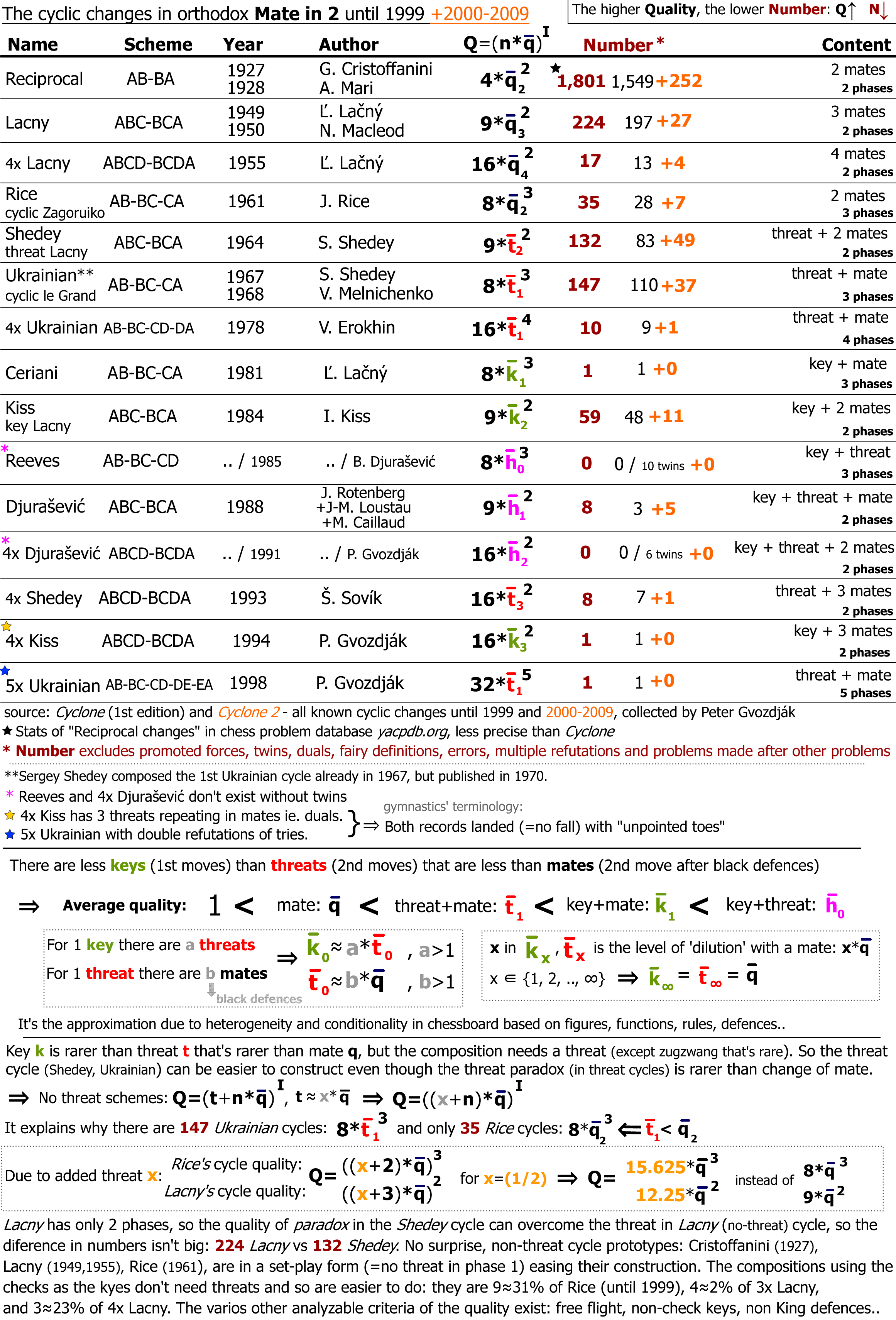
The below table lists the main cyclic themes in the most popular genre in the chess composition: Mate in 2 / #2.
The Librarian, 1566
|
Data of #2 cycles is representative, although not 100% complete.
A few harder schemes: Rice and 4x Lacny preceded the easier: Shedey, Ukrainian, Kiss.
It's because Rice and 4x Lacny are logical continuation or extension of the 1st cycle: 3x Lacny,
and so the composers had been primarely focusing on them.
But later between 2000-2009, there were significantly more Shedey (49), Ukrainian (37) than 3x Lacny (27).
Also the threat cycles include the 'threat paradox' shown by A. Dombrovskis 1958, so the threat cycles couldn't appear before 1958.
The higher quality, the lower occurence holds in gneral eg in: Selfmates, Reflex mates.. or longer #3, #4..
Eg. only 1 Lacny and 1 Kiss cycle exist in #4, which isn't only about difficulty but less composers focused on it.
So data of #2 is the most reliable to analyze.
The number of 3x Lacny since 1950 in decades: 1 1949, 27 50s, 49 60s, 49 70s,
31 80s, 40 90s, 27 2000s. Peaking in 60-70s.
Set of new schemes is finite: falling to 0 by time.
By 2009 3x Lacny in orthodox #2 could be 90+% exploited.
The cycles occuring later Shedey, Ukrainian.. peaks later.
|
And there is a bigger picture. Chess composers are much smaller group than chess
players as all chess composers can play chess, while not all chess players can do compositions.
Since the end of 90s, the youth has become less attracted
by the chess composition
probably by chess too,
due to the rise of PCs, internet / social media absorbing attention, and a higher commercialization.
I started composing the chess problems shortly after the fall of socialism in Czechoslovakia in the begnning of 90s.
Most newspapers had a regular chess problem column with composing competitions. After the regime change, the chess columns were gradually disappearing, while the tabloids with topless women arose..
As a Phd student of economics I elaborated the idea of "
redirection of talent" to explain the rise of chess composition in Slovakia or other then socialistic countries, overcoming the West.
In this view, talented people were "captured" in "alternative activities" as chess composition as they couldn't pursue the productive activities.
I knew it was to fit the "market economy" ideology - omnipresent after 1989.
But, the decline of interest in the chess composition in the late 90s has happened at the West or India too.
And the Czech Republic and Slovakia instead of developing the new technologies (utilising the "supressed talent" before 1989), has lost know-how eg. in heavy and processing industries or agriculture.
And the know-how has declined since 1990s also at the West
mostly due to outsourcing, technologically overtaken by China / Asia.
That's why the rise of the chess composition in the former socialistic countries is rather the spillover effect of then Zeitgeist emphasizing constructivity - despite some restrictions (and all systems have their own restrictions).
Options, Logical Series and Intricacy
Deep Blue computer beated then the best chess player
G. Kasparov in 1996.
But until now
2026, no computer / program or AI can compose the cyclic shifts.
Algorithm / AI can test all positions to identify the cyclic schemes.
It seems unreal not only due to too many options c. (4.822±0.028)*10
44 Tromp + Österlund, 2025, but also difficulty to write identification algorithm.
Shannon number
1950 estimates c. 10
120 chess positions
exceeding the atoms in the observable universe c. 10
80.
Quick estimate is: 32 pieces on 64 fields: 32!*64! ≈ 10
124.52
minus the illegal positions as pawns on the 1st fields, king next to the enemy king...
The cyclic #2 can further exclude eg. less than 6 or more than 30 pieces..
But the chess problems can use a huge set of fairy pieces
Alfil, Camel, Vao.. or rules
Circe, Patrol, MAFF.. with infinite options.
T.R. Dawson
1912 defined
Grasshopper moves along ranks / files / diagonals by hopping over another piece.
P. Monréal
1967 Circe captured pieces reborn on their starting squares,
A.J. Karwatkar
1979 Madrasi 2 pieces of the same type & opposite color attacking each other, can't move, capture, give check..
In 1995, I found a
new class of the rules redefining the mate: MAFF
mate with a free field, OWU
one white unit in the black king's field or mating conditions: AMU
mating unit must be attacked before moving, UIA
the same color unit must be in the activity of the mating unit..
I summarized them in article
New Ideas in Chess Composition in the American journal
StrateGems 2001,
with examples as total 3x3
Shedey impossible in orthodox #2.
Mate with "1" free field
MAFF is one option of
n-MAFFs: mate with "n" free field(s)
n∈{1,..,8}, as
n-OWUs,
n-UIAs..
It reveals the mate or chess itself as an convention definable otherwise.
In 2017 in Kyoto, I met
Tadashi Wakashima, a chief editor of the Japanese magazine
Problem Paradise,
where I had published a few problems, and noticed the section of Japanese chess
Shogi 将棋.
To my surprise, Tadashi told me the Shogi compositions are impressive as in the chess.
It has 9x9 board with 40 pieces incl a few specific ones
Generals, Lances and captured pieces can be dropped back onto the board
similar to Circe.
Quick estimate is: 40!*81! ≈ 10
168.67 positions, legal c. 10
69 Miyako + Kiya + Ono, 2002 - more than chess
and the returning pieces further increases Shogi's options.
Indian 7th cent.
Chaturanga चतुरङ्ग
developed to Shatranj
شطرنج in Persia, inspired Shogi, Chinese / Korean / Burmese or Thai / Cambodian chess..
Some claim the Chinese chess
Xiangqi 象棋 had been the 1st.
The oldest known game, Chinese
Go 围棋 / wéiqí c. 2,000 BC
considered unprogrammable due to vast c. 2.08*10
170≈10
170.32 options
on 19x19 board, Tromp + Farneback, 2016 ,
until
AlphaGo beated then the best
Go player
L. Sedol in 2016.
Quick estimate is
(2 pieces + 1 void): 3
19*19=3
361 ≈ 10
172.24 - more than in chess but only due to the bigger board.
On 8x8 chessboard
Go has max 3
64≈10
30.54 options - far less than chess, so
per board's unit chess has more options due to more pieces
definitions.
The mere 2 types of
Go's pieces
white / black
can't create schemes as #2, #3.. or selfmate, helpmate..
It enables only compositions known as
Tsumego 詰碁 comparable to chess endgame studies.
The N*1-salts is easier to perform than 1*N-salt.
Similarly, logical series of IQ test can have N*1-logics or 1*N-logics.
In my Master thesis in
psychology
1998, I made a test
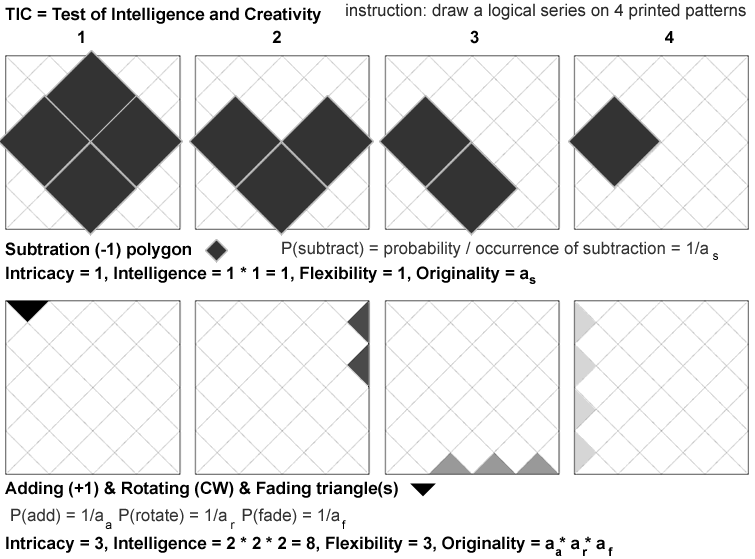
TIC Test of Intelligence and Creativity to assess series drawn on the patterns.
It has 4 different patterns and 16 series of these 4 patterns with 4 iterations.
It's an experimental method to complexly study the IQ and its interrelations.
Instead of selecting the right solution
classic IQ test, the series is created
to capture the IQ, creativity
originality, flexibility.. and projected personality traits.
The valid series contains the repeated sign(s)
=iteration eg. rotation, analogy, sum..
Testing 600+ people, I identified 24 distinct logics from the frequent as adding, alternating to the rare as fading..
Both N*1-logic and 1*N-logics have the same number of iterations, but the score is exponentionally higher for the combined logics.
Flexibility: the distinct number of logics, increases the options to combine logics, so intelligence correlates with flexibility but not 1:1,
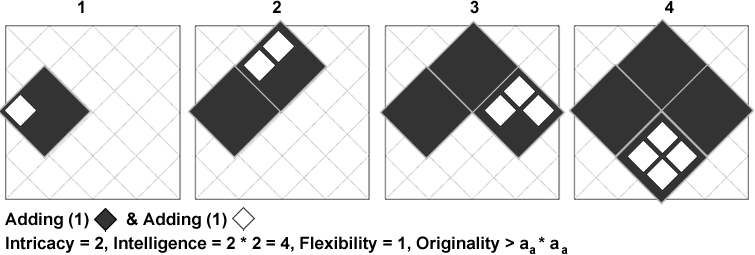
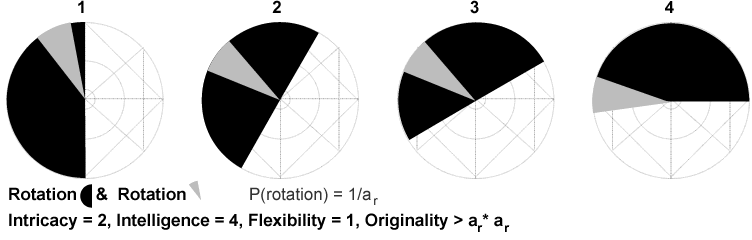
because the same logic can be combined repeatedly into one intricater series. Eg. below is example of Adding white square into black Adding square or Rotation in Rotation.
The intricater series, the higher originality, when the inverted probablities of the logics multiply.
So the intelligence correlates with originality with psychological specifics.
Eg. the intricater series combining the same series as Add & Add & Add.. should be less original than eg. Rotate & Move & Alternate..,
as the 'adding' is the most common
least original logic.
In fact, the intricater series with the same logic is rarer than the combined distinct logics.
If somebody starts drawing 'the adding', it's less likely to get idea to use another adding to 'the adding', than eg. to rotate or move 'the adding'.
As in a math joke: how to decrease the probability of the bomb in the airplane? To bring the bomb!
Because the probability of two
independent bombs is multiple smaller than 1 bomb.
The same logic creating N-series absorbing all iterations explain psychosis.
Like a recursive endless loop in the code absorbing the whole time / memory to halt the whole system.
I clarified this mechanism in part of my Master thesis
1998 as
Model of Schizoprehnia.
Self-identity is a logical series of iterated 'ME': ..ME-ME-ME-ME.. in time and space.
If paranoia aborbs the all iterations, it consumes self-idenity's iterations too, inevitably ending in psychosis.
The content of paranoia is irrelevant
God, Martians, computer.. what matters is the repeated logic eg:
1) "they observe me", 2) I know "they observe me", 3) they know "I know "they observe me"", 4) I know.. etc..
The logic continues until the last iteration.
Although very intelligent persons can suffer from schizophrenia, the probability of schizophrenia decreases with intelligence,
as the higher intelligence
=more iterations per unit of time, the less likely the all iterations would stay in 1 series.
I used a N-die metaphor, where number of throws is iterations: the higher intelligence, the more iterations.
Schizophrenia is like a roll a die would always give 1 series eg: 5, 5, 5, 5.. or 1, 1, 1, 1..
Bi-polar
manic-depressions is like 2 series eg: 5, 5 .. and 1, 1.. or 6, 6 and 2, 2..
N-sided die enables N schizophrenias, and N*(N-1)/2 bi-polars.
N are distinct options
logics that differ in societies /
situations.
Possible personalities for N options are:
N
IQ. Two conclusions are:
1. Probability of schizophrenia is: 1/N
IQ-1, of bi-polar is (N-1)/2N
IQ-1 Both decrease exponentionally
with IQ, and linearly with options.
2. Bi-polar is (N-1)/2 times more often than schizophrenia. Societies with more options
eg. richer / more advanced, have
higher ratio of bi-polar with respect to schizophrenia.
The profession or identity also affects the likelihood of logic.
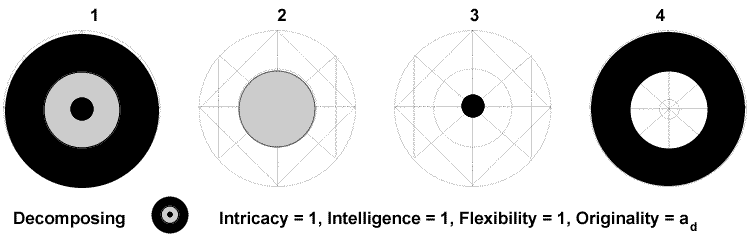
Decomposing is rarer logic in general, but it has been used quite often by people in technical fields,
where the problems to be resolved are decomposed to smaller / simpler units.
A typical example is
integration by parts Brook Taylor, 1715.
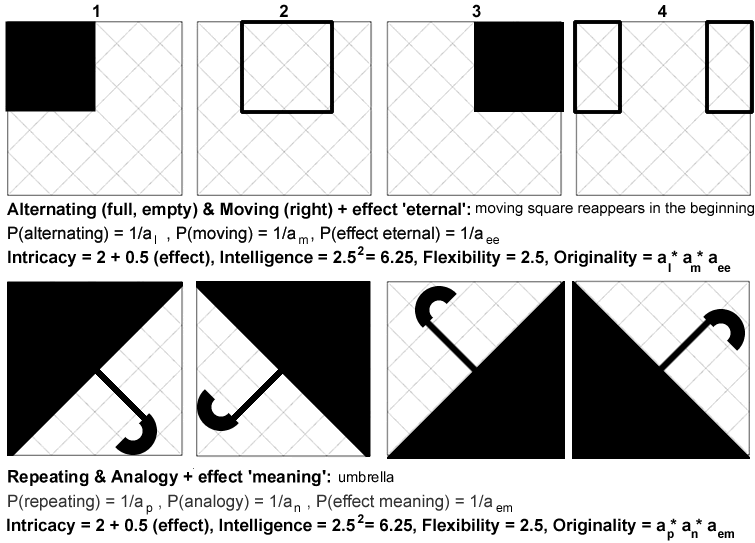
The TIC test can capture various aspects of the projected logic eg. meanings or effects.
"Meaning" is irrelevant to logic but adds something extra as a rotating umbrella.
"Effect" is eg. re-appearing or bouncing of the drawn unit.
Paradox of uniqueness
Calculus in the 17th century was uniquely intricate series.
How is possible that
Newton and
Leibniz invented the calculus independently near the same time?
The uniqueness grows with the intricacy, and chances of multiple discoveries raise too,
as the intricater idea, the less ways how to do it.
It's observable in chess composition with highly intricate schemes.
I composed c. 200 chess problems between 1993-2000, often reciprocal or cyclic schemes.
I discovered the same idea
without knowing of renowned composers 3-times:
V. Rudenko's #2 Lacny
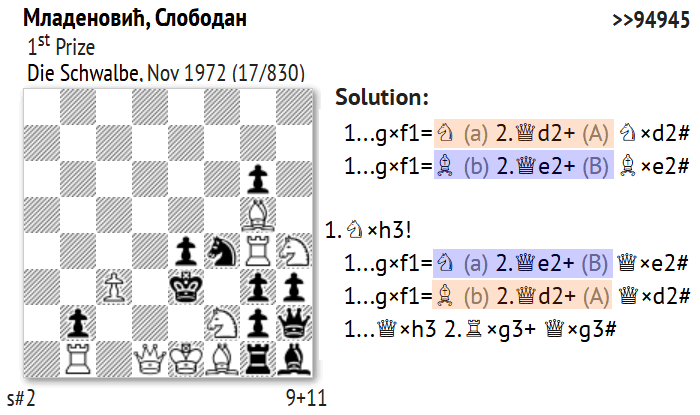
1958,
S. Mladenović's #2 reciprocal self-mate
1972, and
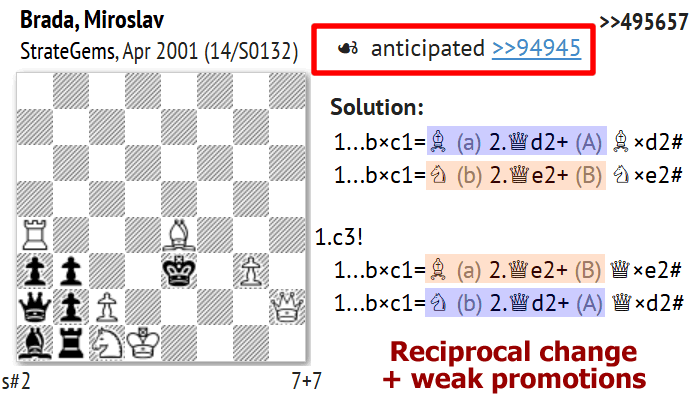
J. Valuška's #2 Shedey
1992.
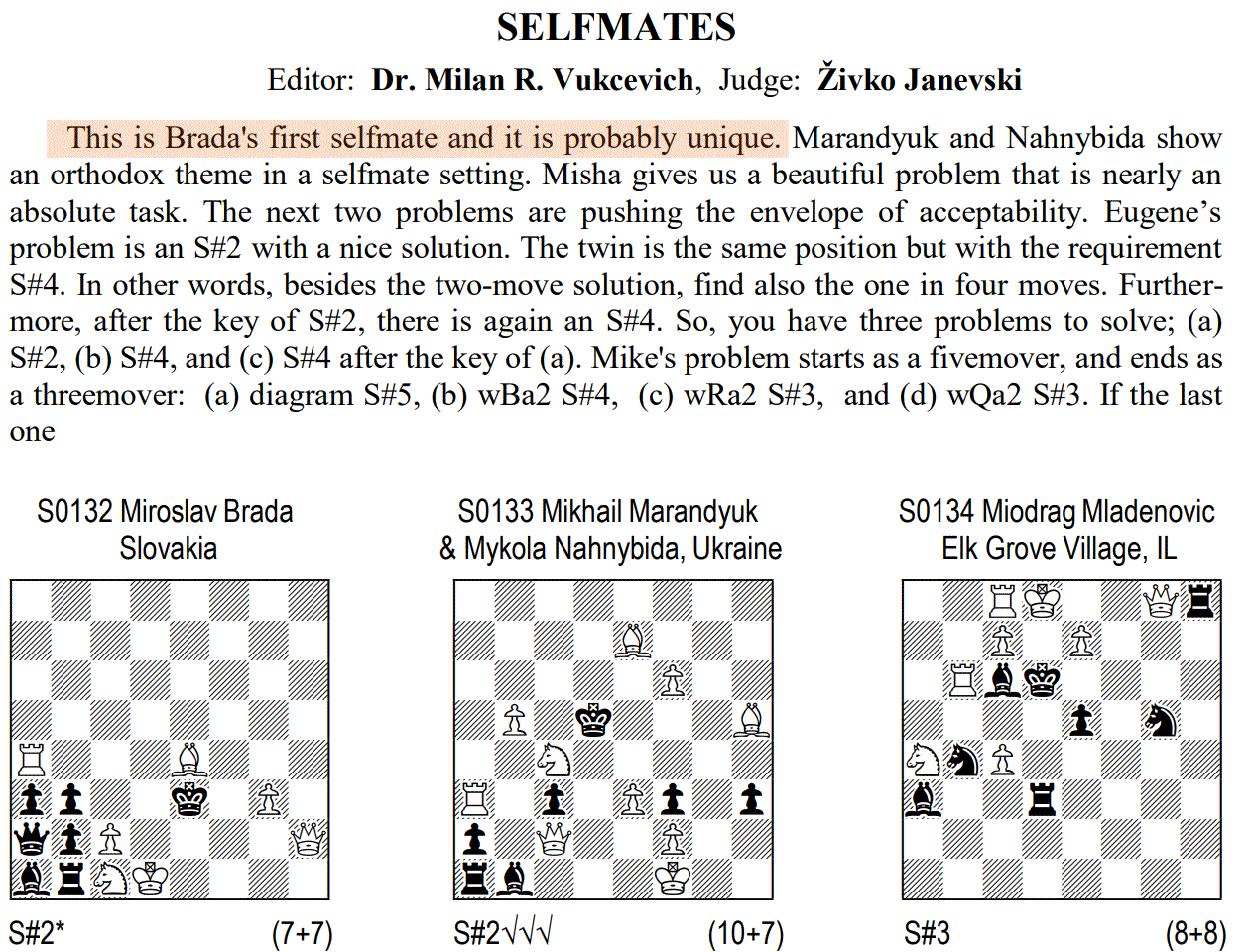
Below is the recurred self-mate.
The editor - the prominent composer
M. Vukcevich didn't recognize the same mechanims from 1972 to write:
"This is Brada's first selfmate and it is probably unique".
The S#2 with reciprocal shift + weak promotions was my 1st self-mate and last problem, done in Dec 2019.
Paradox of uniqueness has surprising insights.
Eg. poetry seems unique as it's improbable that the famous poets
as
Pushkin Пушкин,
Goethe,
Shakespeare,
Ferdousí فردوسی or
Li Bai 詩仙 would write the same poem.
"Same" doesn't mean the exact words, but the plot / mechanism..
Since there are more ways to write poem than to define eg. calculus, poetry is unexpectedly less unique than calculus,
and so paradoxically less likely to recur.
Or: infinitely intricate "
∞-series
S" is unique as it has only 1 way how to do it.
If the other person creates "
∞-series
T",
it's identical to "
S":
S===T, as it has only 1 way.
So the
∞-series must recur,
but because nobody can create
∞-series, it never recurs.
| Title |
|
= |
i↑ |
i=0 |
i=∞ |
| Probability of i-series |
P(i) |
1/ai |
↓ |
1 |
0 |
| Set of i-series |
M(i) |
M1/i
|
↓ |
∞ |
1 |
| People able to do i-series |
N(i) |
N/xi |
↓ |
N |
0 |
| Recurrence of i-series |
R(i) |
N(i)/M(i)
|
- |
0 |
0 |
The recurrence rate
R =
N/(xi(M1/i))
is tricky as
M and
N are interlinked.
Economist M. Kremer
in
Population Growth and Technological Change
1993 finds
a bigger population
in bigger areas
boosts the innovations
spillover and scale effects to enable more people to thrive.
As a result, the bigger areas eg. India / China..
have been more densely populated than smaller isolated areas as Tasmania..
So the number of series
inventions M grows with population
N
that grows with the number of series
M: .. ⇒
M↑ ⇒
N↑ ⇒
M↑..
StrateGems April/June 2001, Vol. 4
| |
During my 1-year grant research 1999 I tested 600+ persons with various tests
including TIC to draw logical series.
I found 20 (=M) distinct 1-series, which wouldn't increase even I'd test 100x more people.
To determine the recurrence rate for the intricacy is to answer:
Does a population able to create series N(i)
falls more or less than a number of series solutions M(i), as the intricacy grows i↑?
TIC captures the IQ and creativity to allow any intricacy: i∈(0,∞).
The TIC series are combinable in M i distinct i-series, diverging M↑↑ as i↑.
And a population able to create i-series decreases as i↑ ⇒ N↓.
So the recurrence in TIC decreases exponentionally R↓↓ as i↑: Δi > ΔR(i).
But the real puzzles / inventions have a finite set of i-series M,
and big discoveries as a wheel, analytic geometry, calculus, alternating power system,
converge to 1 series: M→1.
|
For
M=
1 ⇒
M(i)=
11/i
⇒ the set of series is always 1, regardless of intricacy
i,
so 1 solution can be trivial as well as sophisticated.
A wheel recurred independently in
Mesopotamia c. 4,000 BC
c. 1-2M people,
Eastern Europe
Carpathian Mountains c. 3,900 BC
c. 1M people,
China 2,800 BC
100K - a few millions,
Americas 1,500 BC
Mesoamerica c. 0.2-1M.
Data suggests c. 1M people is a threshold to wheel's invention.
In the 17C, when calculus arose,
Newton's England had c. 5.5M,
Leibniz's Holy Roman Empire 15-20M.
Only a fraction of population counts,
depending on opportunities, abilities, education, motivation to invent.
Eg. literacy in Mesopotamia was <10%, while in 17 c. Europe ≈30%
≈10% women.
The wheel wasn't invented suddenly by 1 person,
but gradually spanning a few centuries.
Calculus also used the earlier ideas of
Descartes 17C,
Euclid 300BC..
So the population involved in inventions cummulates the previous populations,
while only its smaller fraction can invent.
To simplify, the population
N at time of invention can be used,
and
x=
2 in
N(i)=
N/xi
⇒
N(i)=N/2i ⇒
i=
ln2(
N/N(i)),
"x=2" means ≈50% people can create
1-series
invention
to dwindle by
2i as invention's intricacy grows
i↑: 1/4, 1/8..
Then population per invention
N/N(i)
determines the intricacy:
the wheel appears in 1M
=106 ⇒
i=
ln2 106 ⇒
i≈
19.93.
The calculus in 5.5M
17 c. England ⇒
i≈
24.7.
In 2003
G. Perelman from St. Peterburg proved
in 7 years the
Poincaré conjecture,
a century-old math problem, to be more famous after refusing $1M Millennium Prize.
Russian 2003 population was ≈145M ⇒
i≈
27.
These calculations are illustrative to show
the invention's intricacy always grows with a population / time,
since the current inventions cummulate the earlier ones.
But the invention's uniqueness is its change from the initial conditions / time:
(it - it-1)/∑t-1 i.
Newton couldn't invent calculus in Mesopotamia
or the 17C. Australia,
and maybe he wouldn't invent the wheel either.
The wheel could be greater change than modern inventions - but maybe not.
But the later the invention,
the bigger change must be added to be equally significant as the earlier inventions.
Eg. the uniqueness of the change=1 for the 1st invention is: 1/0=∞, 2nd: 1/(1+1)=1/1, 3rd: 1/2 etc..
So the invention's uniqueness falls in time cummulating earlier ideas, unless its change doesn't sufficiently grow.
Google 28 June 2026 answers: "Is
Perelman's proof more unique than invention of calculus?"
"No, Perelman's proof isn't mathematically more unique than the invention of calculus,
but it's vastly more unique in its modern historical and psychological context.
To compare them accurately, we must look at how mathematical ideas are born.
Calculus represents a fundamental paradigm shift that created an entire branch of mathematics,
while Perelman's proof of the Poincaré Conjecture represents a pinnacle of synthesis,
bringing together existing, disparate fields to solve a century-old problem."
The math inventions
set of series
have hugely grown
M↑ since the 17th C., some estimate by 95%.
Perelman combined 5+ math areas, most of which hadn't existed in the 17th C:
Differential Geometry
17th C., Geometric Analysis
1930, Geometric Topology
1935,
Alexandrov Geometry
1941, Ricci flow
1941..
The overall set of series of the combined N fields isn't M
1+M
2+.., but M
1*M
2*.. ⇒
∏Ni=1Mi.
The new invention multiplies the previous options
to expand set of series
M more than linearly,
so 95% growth creates far more new options than it can look.
The population has also grown
N↑ ≈11x in time
t ≈550M
17C to ≈6.1B
2003,
but less than series
M↑↑:
ΔtM>
ΔtN.
So the recurrence rate falls on average
R=
ΔN/
ΔM <
1, as population grows
N↑.
The 3x3
Rubik's Cube
1977 has 43*10
18+ options.
Some estimate ≈1% find
one of 4 known solutions
series
⇒
M(i)=
4.
For
x=
2
⇒
i=
ln2 100 ⇒
i≈
6.64
and set of series
M≈
10,002
⇐
M =
46.644
⇐
M1/6.644=
4
⇐
M1/i=4
⇐
M(i)=
4.
Mere 4
Rubik's solutions indicate the 25% recurrent rate for ≈
1% of population.
The
CFOP solving method
series is the most common, so the recurrence can
differ for each solution, but still growing with the intricacy:
ΔR>
Δi,
as for M≈10,002, there are ≈9,998 wrong series tried by ≈99% people,
versus 4 solutions tried by 1%. It's the 25x higher recurrence:
R
right ≈ 1/4 = 0.25 > R
wrong ≈ 99/9,998 = 0.01.
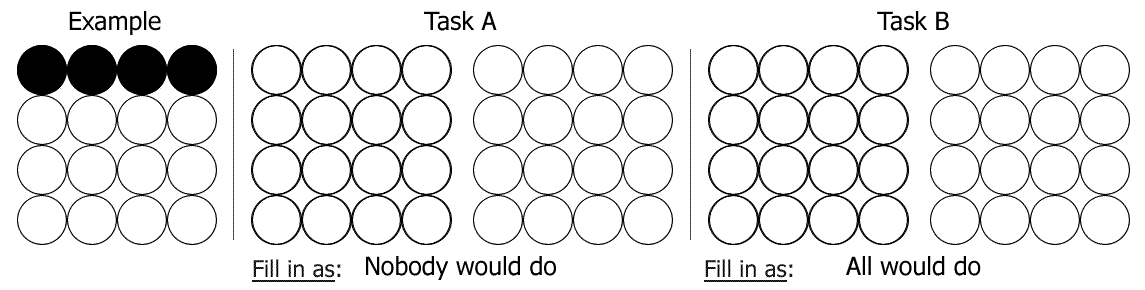
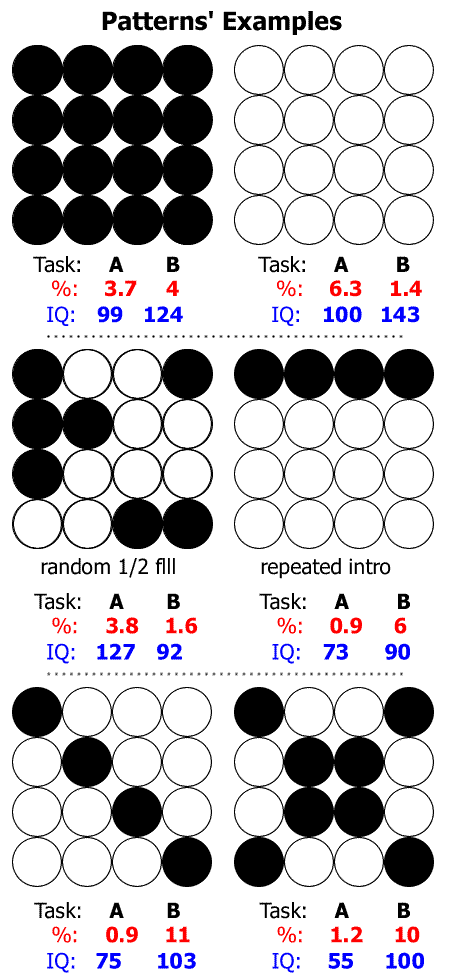
In my 1999 research,
I used
TIC and other own tests eg: "Guess other Guess",
asking to fill in 4x4 circles, 2x as "Nobody would do" and 2x as "All would do".
The example showed 4 upper filled circles.
16 circles have 2
16=65,536 patterns.
The best in
Task A is to randomly fill
in half (8) circles to maximize options: C(16,8)=12,870,
to minimize matches. It was used by av. IQ ≈127
assessed by TIC.
The best in
Task A is 1 option ie. to fill all {16} or none {0}: C(16,0|16)=1, used by IQ ≈124 for {16}, IQ ≈144 for {0}.
The worst for
Task A(B) is the best for
Task B(A).
The
Task A's worst
{0,16} patterns had IQ≈100.
Task B's worst
8 fill random patterns had IQ≈92.
| Testing 600+ people showed '8 full random' patterns in Task A were rarest.
But a decision to use '8 full random' was more often ≈3.8% than some 4-full symmetric patterns < 1%.
The commonest pattern in Task B wasn't the {0,16} patterns,
but the symmetric (4 full) patterns, having IQ ≈100.
So Task B's best choice wasn't the "best" as the majority filled sub-optimal symmetries.
The super intellect IQ→∞ could "guess"
the majority won't fill
the best patterns to mimic the "best" guess, but the sub-optimal guesses diverge.
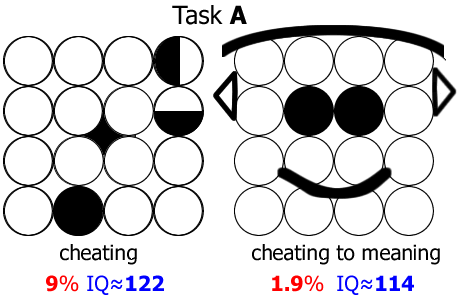
In Task A,
some "cheated" (drawing outside), achieving
unique patterns, but the incentive to cheat isn't so unique
used by 9% of IQ≈122.
1.9% extended "cheating" to create a meaning as face,
used by 1.9% of IQ≈114.
The repeated intro example with 4 full upper circles isn't optimal choice for none of the Tasks,
used so by lower IQs.
The TIC allows higher variability,
ie. TIC's IQ≈55/73.., would score higher by standard IQ tests.
"Guess other Guess" confirms the choice's quality grows by IQ / intricacy.
The high IQ can miss the majority's suboptimal guess
to doubt efficiency of a collective choice.
Many choices are easy, all, regardless of IQ, prefer clean air, water.. or healthy food..
But some specific tasks are unresolvable by the majority's choice.
It then depends on the quality of the criteria and motivation to assign the right experts.
Eg. oligarchies (often masked as democracy) miss motivation to optimize the public choice.
Or some institutions may prevent promoting the ablest, to rid of too able rivals.
|
 |
The population growth
N↑ multiplies
spillover & scale effect the logical series
M↑↑ to outgrow and boost the population growth:
ΔN <
ΔM ⇒ ..
N↑ ⇒
M↑↑ ⇒
N↑ ⇒
M↑↑ ⇒..
The IQ / intricacy
i
reduces a number of series
M(i)=M1/i to 1 or few solutions:
Δi >
ΔM ⇒
i↑ ⇒
M↓↓ ⇒
M→1,
while growing intricacy
i↑
can lead to invention - a new set of series
Mn to multiply the overall set
Δi <
ΔM +
Mn ⇒
i↑ ⇒
M↑↑.
So the formula
M(i)=
M1/i
to be complete must include expectation
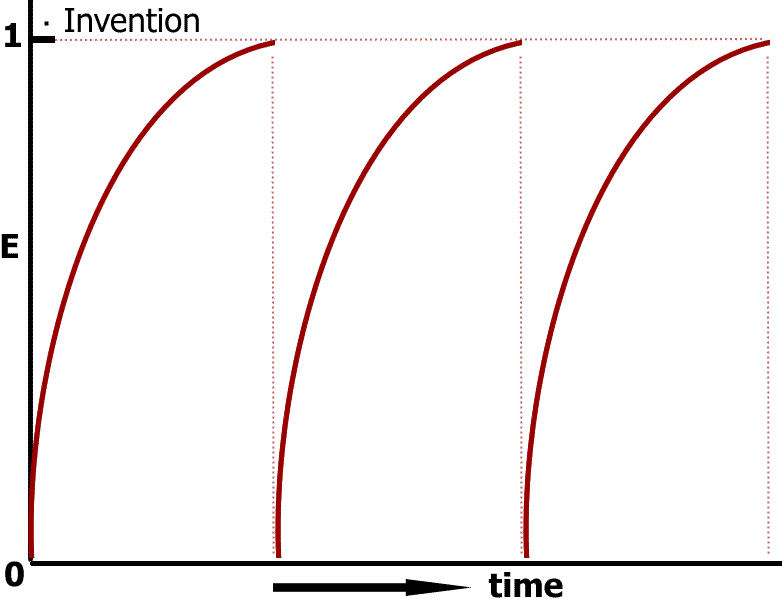
E of the invention
Mn
growing with intricacy
i↑ ⇒
E↑:
M(i)=
M1/i +
E(i)*Mn(i),
where
E∈
(0,1),
i→0 ⇒
E→0,
i→∞ ⇒
E→1.
It can be:
M(i)=
M1/i + (
1-2-i)*
Mn(i).
|
The recurrence R=N(i)/M(i) dynamically changes
to be the most likely
after the set of series M is exploited M→1,
which is a period exactly before the invention
- when it quite likely recurs as:
calculus 17C.,
bakelite
1907: Leo Baekeland / James Swinburne,
light bulb 1879: Joseph Swan / Thomas Edison,
photography 1830: Louis Daguerre / William Talbot,
telephone 1876: Alexander Bell / Elisha Gray..
In contrast,
the periods after the invention are the least likely to bring the new significant invention
to match "Paradox of uniqueness": the uniquer inventions, the higher probability of their recurrence.
Of course, there are inventions as Perelman's proof not re-discovered by anyone else, but the multiple discoveries are more often
than "common-sense" would expect - as the inventions need opportunity and high intricacy excluding the majority.
|
|
Interestingly, all of my 3 recurred compositions were of the Slavic composers.
Moreover
Ján Valuška is from my home town Zvolen in Slovakia, although we weren't meeting,
and
Valentin Rudenko was from Dnepropetrovsk, the home city of my grandmother.
As a leading designer in
Yúzhnoye Южное, the main soviet aerospace and defense manufacturing facility,
his team constructed 60+ science satellites.
Finally Slobodan Mladenovic' was one of the most distinguished Yugoslav
Serbian composers.
The recurred schemes of composers speaking Slavic languages
Slovak, Russian, Serbian.. could speculatively indicate
that certain ideas / associations are likelier in certain linguistic groups.
The cyclic changes are more common in Slavic spoken countries, when Slovakia is per capita the most "cyclic nation"
with several cyclic prototypes.
Nevertheless, many cyclic problems arose by non-Slavic spoken composers including Indians.
3 recurred compositions isn't a big sample, so they could happen randomly, but an underlying logic can be explored.
A declension
inflection of nouns / pronouns / adjectives
is typical for all Slavic languages
except Bulgarian / Macedonian
with the changing endings.
Eg. in English you say: "a rose", "of a rose", "give a rose", "about a rose", "with a rose",
while in Slovak: "ruža", "od ruže", "daj ružu", "o ruži", "s ružou" - that's particularly difficult for non-Slavic speakers to learn.
And the inflection of the same word ressembles a changed mate / function in the cyclic or reciprocal changes.
One of the most prolific chess composer in history Bulgarian
Petko Petkov with the most points for his compositions in the FIDE albums - never constructed the cyclic shift of mates.
Bulgarian is the only Slavic language without declensions, which could explain a lot less cyclic problems
on average done by Bulgarians in comparison with other Slavic nations.
Surely, there are more influences forming the spread of certain logic,
but the possibility that some types of schemes are likier in certain linguistic / cultural groups can't be excluded, and the evolution of the chess composition enables to study it.
Evaluation of Art
(∑Nn=1 An2) i
 |
In Czech journal Světozor 1869,
the painter and chess composer Antonín König
described the chess composition as an independent form of Art
to initiate the Bohemian School Česká škola úlohová,
the 1st art movement elevating chess composition beyond the mere puzzle.
It preceded and most likely facilited the neo-strategic school of multi-phase logic.
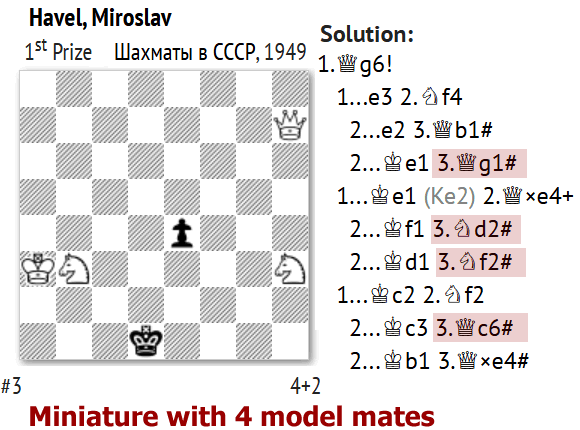
The main rule is the model mate: the all mating fields
are attacked or blocked just once, and the all white pieces participate in a mate.
It's the extra criterion with new combinations suiting #3 or more movers.
It gradually produced the unseen quality gaining the international recognition.
The miniature #3 with 4 model mates
of the leading Bohemian Czech composer Miroslav Havel a real surname: Košťál is a classic example.
By time the "model mates" options had been exploited,
and the neo-strategy provided more combinations.
|
Paul Cézanne
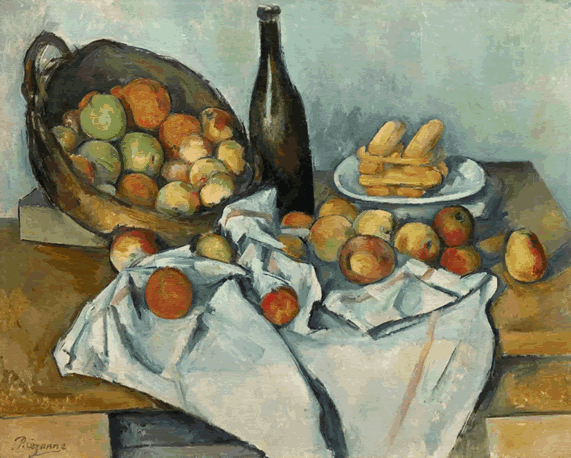
Le panier de pommes, 1893
|
The Bohemian school is the milestone in the chess composition comparable
to the Cézanne's 1879-1880
post-Impressionism of distinct viewpoints recalling "model mates".
The multiviews in eg. "The basket of apples" is unreal as the "model mates"
are unreal in a classic puzzle.
The prestigious exhibition "Paris Salon" was rejecting Cézanne's works.
Eg. "Portrait d'Achille Emperaire" 1870
was refused due to unreal incorrect perspective and anatomy.
The realistic depiction remains valid criterion, as the difficulity to solve remains valid for a puzzle.
But Cézanne depicted reality, his apples look like apples.
He enhanced, not replaced, the criterion: the multiviews of the "same" reality.
The 1st criterion to "depict reality" is a copy "A" of the real "A"
multiplying "A": A2.
The more real depiction, the higher A.
Cézanne's copies of: apples A1, bottle A2, table A3, basket A4, plate A5, tablecloth A6..
are realistic enough, and the multiviews add the intricacy
multiplying the copies:
(∑Nn=1 An2) i.
The intricacy of the
|
multiviews exceeds the "copy of the reality" to define the modern art
having the higher value
lower probability than classic art better imitating
copying the reality (with distortions to increase the impact) as
Michelangelo's David
1501.
The classic puzzles maximize the difficulity to solve: the trickier
more obfuscated solution, the better puzzle.
Americans
Sam Loyd 1841-1911
and
William Shinkman 1847-1933, born in Bohemia
mastered the surprising and paradoxical keys.
The composition's various variants lead to the mates
M1+
M2+..
Mn
=
∑Nn=1 Mn.
The less likely average
M, the higher composition's value.
The Bohemian school maximizes the number of "model mates"
- the extra criterion altering the composition's structure to higher use of the pieces.
The set of "all model mates"
∑Ɵ is a tiny fraction of the set of "all mates"
∑M,
so the model mates' compositions:
∑Nn=1 Ɵn,
are rarer on average.
Some unusual variants of mates
Mx can be rarer than the model mates
Ɵx:
Mx >
Ɵx, but the other mates
My/z.. are likely more often than the model mates
Ɵy/z..:
My <
Ɵy,
Mz <
Ɵz..
The composition sums its all mates, so it's far likelier the model mates' compositions are rarer
uniquer than classic puzzles.
So the modernity isn't a mere deviation,
it
adds a criterion multiplying the options.
The deviation destroying "
copy of reality" degrades the art to randomness.
To realistically copy the reality is the 1st inevitable criterion.
In 1958,
John Gurdon cloned (=
copied) a frog from the somatic cells.
In 1903,
Wright's brothers studied birds to grasp lift and balance (=
copy) to make the 1st airplane.
Da Vinci
1452-1519 invented techniques eg.
Sfumato
to mimic (=
copy) human vision.
To bend perspective in multiviews
Cézanne simplified objects
A↓ to geometrical shapes
that inspired
G. Braque 1882-1963 &
P. Picasso 1881-1973
to extend the idea in Cubism
1907. The cubistic "
copies of reality" further simplify objects
A↓↓
to deepen multiviews
i↑.
So there is a tradeoff between quality of the realistic copy
A, and the intricacy
i,
when
Arealism >
Amultiviews >
Acubism,
while
irealism <
imultiviews <
icubism,
where
A+
i=
X.
The intricacy
i exponentionally increases the value,
but decreases the quality of
A.
The graphs below illustrate it for various values of
N and
X.
Both growing number of
A ⇒
N↑ and options
X↑,
increase the intricacy
i↑ with respect to
A to reach the maximum.
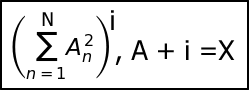 (∑Nn=1 An2) i
can assess seemingly unrelated fields
by various values of
A,
N,
X,
i.
The realism copies excerpts of the reality
to maximize
A↑ and
N↑ in
N*A2.
It's the 1st inevitable criterion,
so every field includes the realism's parameters:
A,
N.
Mannerism
16th C intentionally changed some realistic attributes of
the realism
N*
A,
as the proloned neck of
Parmigianino's "Madonna dal collo lungo"
1534-1540.
It's like adding an intricacy to the formula:
N*
Am*
i, subject to
Am+
i=
X.
Arcimboldo promoted Mannerism using objects creating other object as "Librarian"
1566 from books,
but book in itself has no multiuses.
The
Cézanne's multiviews elevated the intricacy exponentionally
(N*Av2) i,
as it reuses the "same" in itself (eg. the same apple in distinct views).
|
The cloning of the organism isn't mere copying the image, but far complex DNA R ≫ A,
with more elements Nr: Nr ≫ N.
The 1st film "Roundhay Garden Scene" 1888 by Louis Le Prince, was a silent 2.11 sec series of B&W pictures.
Pics' sequence exceeds the quantitative extension of the painting,
it creates a new quality: "motion" copying the dynamic reality.
The chess is zero-sum game. The check-mate M is an abstract convention copying the battle.
The mate M is a tiny subset of the all moves,
while the mate M1
in the chess composition is a tiny subset of the mates M.
The chess problem deviates to overcome the zero-sum game, to meet extra criterion as Mate in 2.
Let's compare eg. 3 real units 3A, whose qualities lower by 20% in Multiviews and by 60% in Cubism.
Evaluation is for Realism 3A2, Multiviews (1.92*A2) i =(3*(0.8*A)2) i,
Cubism (1.08*A2) i =(3*(0.6*A)2) i.
|
| Realism |
BC |
N*A2 |
A > 1
| | Chess |
7C |
N*M | |
| Chess problem |
9C | i*N*M1 |
M1 > M, i>1
| | Mannerism |
16C | i*N*Am2 |
A > Am, i>1
| | Model mates |
1869 | (N*M2) i |
M2 > M1, i<2, M2=Ɵ
| | Film |
1888 | Nf*Af2 |
Nf > N, Af > A
| | Multi-views |
1893 |
(N*Av2) i |
A > Av, i ∈ (1,2)
| | Cubism |
1907 |
(N*Ac2) i |
Av > Ac, i ∈ (1,2) |
| Neo-strategy |
1927 |
(N*M1) i |
i ∈ {2,3,4..} |
| Cloning |
1958 | Nr*R2 |
R ≫ A, Nr ≫ N |
|
For
A=2, to have the same values, the intricacy in Multiviews is:
i≈1.2, in Cubism:
i≈1.7.
The chess problem has higher value than chess, as it's much harder to construct the valid problem than "play chess".
That's why the PC algorithms beat the human in chess, but can't
so far compose the quality chess compositions.
The most valued chess plays are with unexpected combinations, the closest to chess problems / studies.
Classic chess problems minimize the probability of the keys / check-mates
M1,
Bohemian school maximizes the number of the model mates
M2,
and neo-strategy maximizes the changes of the mates
M1 and related functionalities in the multi-phases.
Unlike
Cézanne's multiviews (a bit reducing the quality of
A =copied unit due to reuse in the multiviews), the "model mates"
increase the quality of the mate
M2 that's rarer than "ordinary" mate
M1.
But the (very) unexpected key can make the "ordinary" mate
Mx rarer than the "model mate"
M2:
Mx>
M2.
So in the chess problem assessment:
i*N*M1, the intricacy
i maximizes improbable combinations to increase the value of the mate:
i*M1=
Mx, where
Mx>
M1.
The better problem,
the higher difference
Δ(Mx-M1)↑.
The "model mate"
M2 is on average rarer than the ordinary mate
M1, but can be less rare than the problem with the (very) hidden key:
Mx:
Mx>
M2>
M1.
Nevertheless the model mates's value surges with the intricacy
i: (
N*
M2)
i
i∈
(1,2). Because the model mates aren't the same
⇒ i<
2.
In the neo-strategy
the intricacy
i exponentionally increases the value of the mates:
(
N*
M1)
i, where
i ∈
{2,3,4..},
as the changed mates
M1 are the same
in reciprocal / cyclic shifts.
For eg. a problem with 2 distinct mates,
with
Mx=
2,
M2=
1.5,
M1=
1,
the value of the "classic puzzle" is:
2*
Mx=
4,
"model mates":
3 i,
"reciprocal-change":
2 i.
For the same value
4, the intricacy
i
in "model mates" is:
i≈
1.26, "reciprocal change":
i=
2.
In fact, the keys of the classic problems aren't usually 2 times rarer than in compositions with "model-mates" / "neo-strategy",
which are also often tricky to solve, as they contain various variants and tries.
The presented calculations are illustrative,
more exact calibration is possible, eg. keys' probabilities can be
estimated from structural options
different in classic, "model mates" and neo-strategic compositions
or empirically by the time in which the solvers find the keys in classic, "model-mates" and "neo-strategic" problems.
Invention, Assessment, Price
Invention is a devation of a form or content with added intricacy i↑, keeping the copy imitation of the reality ≈A.
It's within the field as Cubism, Neo-strategy, Quantum mechanics..
or it's a new field based on the new technology as photography, film, PC, internet..
It decreases probabilty to increase uniqueness, independent of time and space.
Gaugin's "Tahiti girls" 1890 seemed 'unique' in Paris as Paris seemed 'unique' in Tahiti, but the real art is unique in Paris as well as Tahiti..
So it has value by the way Gaugin painted it, not because of Tahiti..
The deviation in itself reduces
the value - if it devalues the imitation of reality A↓ without sufficient compensation ≈i.
Deviation adds options o to imitation A,
as Parmigianino prolonged the neck in the 1st manneristic painting 1535.
It's realistic (≈A) only intentionally extended (=o).
But all things (=N) can be longer: N*o, so the prolongation is uniquer only temporarily: U=A*(1+time*(o-1))/N*o time ∈ (0,1).
H. Bosh 16C deviates by various proportions + unreal combinations: N*o1*o2*..
Impressionism 19C deviates by blurring, Warhol's "pop-art" 20C by colors..
So the chronology of the invention is the 1st quality criterion: the earlier, the higher value on average (=not always).
It indirectly includes the quality,
when to be 1st indicates the distinction from the previous ideas,
which is in itself improbable unique.
But it's insufficient due to possible multi-discoveries, and mainly
due to the other criteria.
The greater invention, the more new options, and as was shown
the ideas multiplying the existing options as Cézanne, Neo-Strategy..
create more options than enhancing or changing parameters: ≈Ai > i*A.
The priciest paintings 2025 ranks Cézanne's "The Card Players" 1892
the 3rd $250M in 2011,
Picasso's "Les Femmes d'Alger" 1954 the 9th 179M in 2015,
and da Vinci's "Salvator Mundi" 1500 the 1st $450M in 2017.
The most highly insured painting is "realistic" da Vinci's "Mona Lisa" 1503-1519 $100M in 1962 to be $1.1B in 2025.
The price isn't 100% objective as it's changeable and not finite,
and many famous paintings aren't for sale,
it shows that the new idea (eg. multiview) isn't automatically more valued or better than the before idea (eg. realistic depiction).
Surely, it depends on the quality of the concrete painting when eg. a substandard "cubistic" work can have lower value than
a quality realistic work.
The real value resides in the quality difference Δi in comparison to other works.
Eg. "Horses" 20,000 BC of the cave man, could be the bigger difference than eg. Picasso's "Le Rêve" 1932..
But how likely it is?
The invention enforces certain quality eg.
the "neo-strategy" compositions have various qualities,
but a substandard "neo-strategy" composition is improbable -
like a successful somersault needs a certain style.
The higher intricacy n↑ of n-jump as eg.
a quadruple Axel, the likelier the flaw is, but
paradoxically for successful n-jumps:
the higher intricacy n↑, the probably better style - because any flaw would
likely destroy the intricate jump.
So the invention to be the invention is flawless.
And the more inventions the art contains,
the higher value uniqueness and more probable it's worthier than arts with less inventions.
As eg. a space rocket is uniquer than a car.
The assessment of the invention can confuse 3 partially independent aspects:
● sophistication a "simple" eg. wheel versus an "advanced" eg. space rocket..
● significance of the change from the previous inventions..
● market value.. |
Paul Gauguin
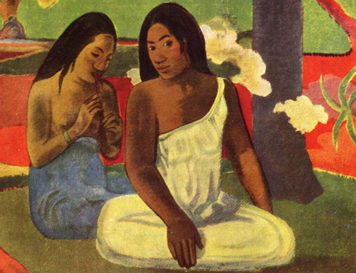
Women of Tahiti, 1891
F. Parmigianino
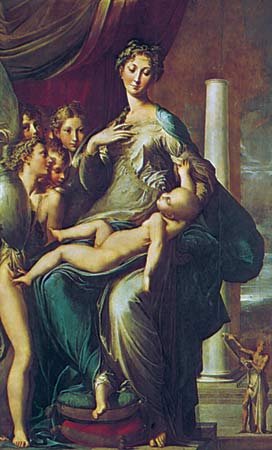
La Madona del cuello largo, 1535
Andy Warhol
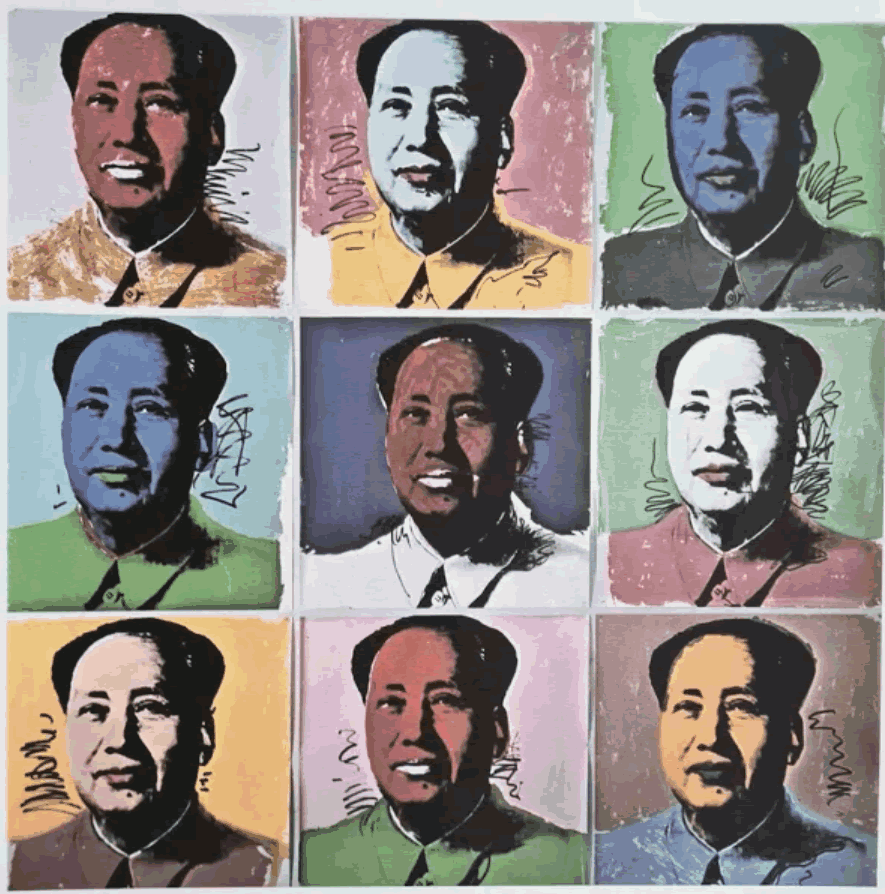
Mao, 1972
A cave man
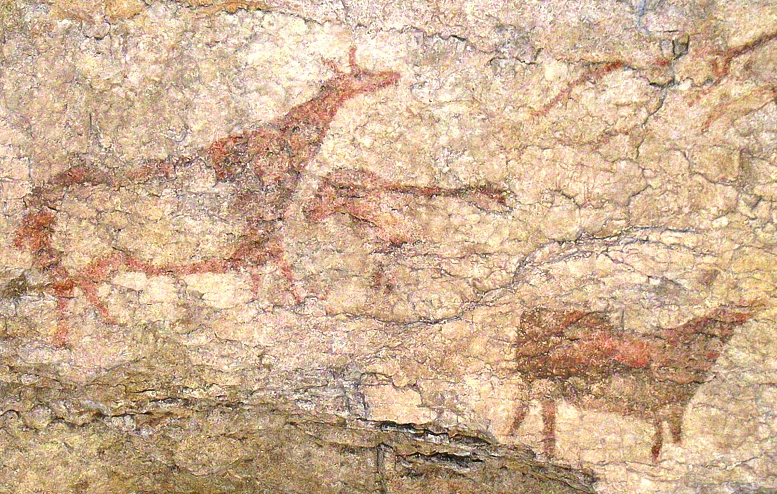
Horses, 20,000 BC
|
Why pioneering compositions of
G. Cristoffanini or
A. Mari
have practically no market value, while
Picasso's works are sold for millions?
Why footballers earn on average far more than gymnasts or figure skaters,
while the gymnastics is far more sophisticated than a football?
Or why chess or GO players earn far less than tennis or golf players,
but far more than chess composers?
"Market size"
far more footballers than figure skaters
can't fully explain it as eg. "World Athletics" has 70K competitors:
c. 7x more than 9.5K professional golfers, while in 2026, the top golfer
T. Woods had $
1.3B,
14.4x more than the richest athlete
100m recorder U. Bolt's $
90M.
Or F1 driver
M. Verstappen makes $
78M a year, while there are mere 22 F1 drivers.
Forbes 2026 lists top annual on-field earnings:
C. Ronaldo $235M soccer,
C. Alvarez $160M box,
J. Rahm $97M golf,
M. Parsons $83.4M American football,
M. Verstappen $78M Formula I,
K. Tucker $68M baseball,
S. Curry $59.7M basketball,
C. Alcaraz $23.5M tennis.
In contrast, annual incomes of top chess or GO players is: $
1-1.4M,
top figure skaters: $
700K, classic gymnasts: $
100K..
So the simpler zero-sum games earn disproportionately more than sophisticated fields as gymnastics.
Again it may seem due to the popularity determining ad revenue,
eg. football is accessible and easy to play unlike jumping saults / pirouettes,
so logically the public pays more for football.
Also the evalution of simple zero-sum games is easy as number of goals,
while gymnastics's score assessment reduces the mass interest.
It's in any society, but capitalism
market economy
amplifies the role of a profit, so the intricate less popular fields can disappear or not arise.
The "price" reveals a discrimination against intricate as well as mental fields.
The mental gymnastics as chess composition requires the understanding of the idea to appreciate it - which diminishes the audience,
while pirouettes of figure skaters are visually obvious to enjoy.
So mental chess / GO earns disproportionately less than physical sports,
but at the same time, disproportionately more than mental gymnastics as chess composition or math.
Nevertheless, the unduly huge money in football, golf, F1.. and also certain "art sales" is also a result of money laundering and tax evasion,
which needs to be covered up by certain "turnover volume".
In sport it's connected with betting industry..
Google 31 Aug 2026 answers: "Is football and art used to money laundering and tax evasion?"
"Yes, both the football soccer industry and the fine art market are extensively used by criminals, corrupt officials, and wealthy individuals for money laundering and tax evasion.
Both sectors share two primary vulnerabilities that make them highly attractive for financial crimes: extreme opacity lack of regulatory transparency and highly subjective valuations. Because the "true value" of a professional athlete or a painting is whatever someone is willing to pay for it, criminals can easily move, hide, and legitimize huge sums of "dirty" cash."..
By adding: ".. through betting industry?" -
Google says:
"Yes, football and art are heavily exploited for money laundering and tax evasion, but they do so through entirely different mechanisms rather than a combined use of the betting industry. While the betting industry is a primary tool for football-related financial crimes via match-fixing, the art world relies on privacy, subjective pricing, and offshore storage freeports to move illicit wealth independently."..
The price of the art can't objectively assess its value in terms of intricacy, novelty, significance..
So the inventors aren't primarily driven by expectation of a profit.
It's more improbable than probable that thinking time would
on average return in a commercial success.
Eg.
George Boole had no profit from his unique algebra
1847,
a math foundation of computer science.
The invention can even lead to a degradation as imprisonment of
G. Galilei 1633.
That's why thinking in itself is a value for inventors, regardless of (expectation of) money.
Eg.
Cézanne was from a wealthy family
and would gain more pursuing his father's banking career,
than the innovative painting, which was a dispute with his father.
Buddha Siddhartha Gautama gave up
6BC his royal privileges to "seek liberation".
The renowened philosopher
Heraclitus 500BC
gave up his aristocratic privileges to focus on thinking..
Or a lawyer
Pierre de Fermat 17C born
wealthy, devoted his leisure to his pioneering math discoveries. It defies classic economics maximizing the profit and leisure (=no effort)..
It coincides with
Maximization of Uniqueness (=improbability), a refinement of utility that I developed as a PhD student of economcis
2000:
The richer you are, the less equally rich or richer people. The richest is only one (=unique).
Maximization of richness or leisure (=classic utility), maximizes the uniqueness (=improbability)
that can be maximized also by: extreme sport, suicide, tattoo, count of views...
The richest seem unique as the poorest, but the rich can easily become poor, while the poor can
hardly get rich. So the aim of maximization reflects IQ and options. Few options increase
irrationality, regardless of IQ..
Utility maximizes values:
U=
∏Nn=1 an,
constrained to iterations:
∑Nn=1 an =
Time.
What's better.?
● 2 equally healthy children (=2a)
● 1 very healthy (=a+x) and 1 very sick (=a-x)..?
The equally healthy children are
on average better off as: a*a=
a2 > a2-x2=(a+x)*(a-x),
that's
The law of values' equity maximizing overall value across all values.
The extreme can be worthwhile, but it's improbable as it needs to be overcompensated.
The intellect
IQ has a role in a realization of values per unit of time.
Excesses are often due to unawereness
IQ↓, in real time, of their negative impact (-x) on other values.
Eg. a striptease in front of public increases the uniqueness (+x) at the expense of a later punishment (-x) reducing overall uniqueness.
The detriment (-y) is usually not the same as gain (+x), and excesses are often a lot more detrimental than gains:
y ≫ x.
Maximization of uniqueness is maximization of improbabilities or minimimization of randomness.
To be hungry / dirty / ugly.. is likelier
more random than to be no-hungry / clean / pretty..
The invention is also an excess with a detriment (-y) eg. more spent time, although the gain (+x) can be far bigger:
x ≫ y.
In economics, a consumption
value has higher utility now than in future:
a/(1+B)time B>1.
The intellect
IQ can deterioriate by eg. alcoholism, but
in standard conditions doesn't change.
Although money increases the utility
happiness via higher consumption in economics, it doesn't affect the IQ - values realized per unit of time:
available iteration utilized in structures of various probabilities.
I remember a happy moment when I grasped the
neo-strategy far less likely than classic puzzles with improbable keys.
Chemist
J. Crusats described it to me: "
Oh my God! The world should stop to admire this!"
So the realization of
the higher order logic creates the happinnes independent of money.
The IQ
iterations isn't changed during or after this realization, it only employs less probable structures.
So the same iteration
∑Nn=1 an =
Time, can have qualitatively various distributions.
And certain realizations
logics need certain amount of iterations.
Part of
IQ iterations is always consumed by self-identity series
in time and space: ..ME-ME-ME..
The remaining
IQ iterations is consumed by other realizations.
Eg. the same 10 iterations can be all in 1-series
autism, meditation.., or in 5 combined series of 2 iterations: 2
5=32 options.
The various series exist due to criteria / definitions: the more criteria, the more possible series and their combinations.
In the sport runs, the quality depends on 1 criterion "time": the faster, the better.
A marathon takes 2+ hours
35-55,000 steps, 100m sprint 10+ seconds
40-60 steps.
A run combined with other definitions eg. a jump, needs other criterion of assessment.
The high jump takes a few seconds
8-12 steps but it doesn't indicate the achieved height.
The acrobatics adds eg. rotation, when neither time nor jump's length can assess its quality.
Running is basic inevitable or
horizontal iteration, and other definitions add
vertical iterations making the quality evaluation more intricate.
Eg. assessment of the gymnastics's floor 1+ minute performance
covers: "
a routine's difficulty D-score & execution E-score, focusing on tumbling precision, dance elements, artistry, & technical skill"..
|
The distributions of iterations create options quality defining the activity.
Eg. figure skating in 1-2 minutes transforms iterations to variously organized jumps of various qualities.
Mate in 2 #2 with 3 basic iterations =2 white + 1 black moves transforms interations to schemes of various intricacies.
The speed is the 1st criterion. The higher speed, the more iterations per unit of time.
The world records show the average speed of marathon: 21.2 km/h, of 100m: 37.6 km/h.
The both records are the top performances, so have approximately the same quality.
The marathon is slower as it lasts much longer.
Like chess end-game studies are longer =more iterations in longer period with less intricate =slower schemes than in #2, #3.
So the lower qualities eg. slowness can have the same or higher overall quality, if persist long enough.
Eg. 200m has ≈99.7% ≈37.5/37.6 speed of 100m,
and marathon ≈56.4% ≈21.2/37.6.
Comparing the speeds of double distances for various lenghts are surprising.
Eg. 100m is ≈1.03 faster than 200m, 200m is ≈1.12 faster than 400m,
400m is ≈1.18 faster than 800m, 1.5km is ≈1.06 faster than 3km,
and 5km is ≈1.04 faster than 10km. |
| Running World Records |
| Meters | Record | km/h | | |
| 50 | 5.56s | 32.4 | 1996 | D.Bailey |
| 60 | 6.34s | 34.1 | 2018 | C.Coleman |
| 100 | 9.58s | 37,6 | 2009 | U.Bolt |
| 200 | 19.19s | 37,5 | 2009 | U.Bolt |
| 400 | 43.03s | 33.5 | 2016 | W.V.Niekerk |
| 800 | 1:40.91 | 28.5 | 2012 | D.Rudisha |
| 1,500 | 3:26 | 26.2 | 1998 | H.E.Guerrouj |
| 3,000 | 7:17 | 24.7 | 2024 | J.Ingebrigtsen |
| 5,000 | 12:35 | 23.8 | 2020 | J.Cheptegei |
| 10,000 | 26:11 | 22.9 | 2020 | J.Cheptegei |
| 42,195 | 1:59:30 | 21.2 | 2026 | S.K.Sawe |
|
So the difference in speeds between 400m and 200m or 800m, are significantly higher than between shorter: 100m and 200m, 1.5km and 3km or 5km and 10km.
Google 18 Sep 2026 says:
"Your observation is spot-on. Looking at world record paces, the drop-off in average speed from the 200m to 400m, and from the 400m to 800m, is massive compared to the tiny changes between the 100m–200m or 5,000m–10,000m brackets"..
.."The main reason for this discrepancy comes down to energy systems, fatigue curves, and the mechanics of the running start.When looking at average speeds across different track events, the drop in velocity isn't linear"..
| Running over hurdles World Records |
| Meters | Record | km/h | N | per meter | height | | |
| 60 | 7.27s | 29.11 | 5 | 12 8.3% | 1.067 | 2024 | G.Holloway |
| 110 | 12.80s | 30.95 | 10 | 11 9.1% | 1.067 | 2012 | A.Merritt |
| 400 | 45.94s | 31.34 | 10 | 40 2.5% |
0.914 | 2021 | K.Warholm |
| So already a simple run has its own non-linearities irregularities that grow with other criteria.
Eg. hurdling run+jumps takes more iterations per unit of time
in dependence on the hurdles' density, height, 1st position..
110m hurdles has higher density and height than 400m hurdles,
so it consumes less horizontal but more vertical iterations.
As a result 110m's speed is 0.99x slower than of 400m.
|
The vertical iterations grow up from the "running" horizontal iterations,
so they create N-series
where N>1 combining 2 or more 1-logics.
The hurdle is jumped during the run, combining run + jump, to consume more iterations
per unit of time than a simple run.
Eg. mere 5 iterations can be distributed: ● all in a run: 5x1=5,
● 3x in a run and 2x in a jump: 3x2=6.
The logical series needs at least 2 iterations, excluding distribution: 4x in a run and 1x in a jump.
So 110m hurdles transferred to 400m hurdles configuration
hurdles density, height.., would be a bit longer than 400m, and that's why 110m hurdles is slower.
So something shorter can have in some criterion lower quality
eg. speed to have the same or higher overall quality by other criteria.
Eg. an approach run in a long / high jump or a paul vault is slower than a simple run.
But the high jump
flop is more than run+jump, it's a complex technique
series to maximize the vertical height.
It's more like gymnastics than a run, with iterations distributed in: an approach run + jump + rotation + back arching + landing..
The paul vault is distributed in: 1) run, 2) pole carry, 3) plant, 4) takeoff, 5) swing-up, 6) rock back, 7) turn, 8) clearance..
Iterations added to the actual series, create intricater, ie. less likely, series.
So the amended Utility formula is:
U=
∏Nn=1, x=1 anx
with extra exponentional parameter
x differentiating intricacy
weight of each value
activity.
The performances aren't interrupted, eg. marathoners can't run 1/3 marathon today and 2/3 marathon next month.
Or gymnasts can't jump a few saults to take a rest at home to continue later.
Also in mental fields as math olympiads, exams, chess / GO matches.. or any competitions need a time limit to compare the results.
But, artistic, scientific, construction.. works often don't arise in 1 ceaseless session.
They are often interrupted and can take months or years.
Eg.
J. Joyce spent 17 years to finish novel "Finnegans Wake"
1939,
J. Brahms was composing "Symphony No. 1 in C minor"
1876 21 years,
or
J. Harrison developed "The Marine Chronometer"
1773 during over 40 years.
The intricate idea to be developed is so break down to smaller parts, which can be resolved independently in various periods.
If it's a work / idea of one person,
his IQ
iterations per unit of time
is repeatedly re-used untill a completion.
So the idea sums the same IQ
iterations once or more times:
Idea=
∑ƮƱ=1(
∑Nn=1 an =
Time)
Ʊ, where
Ʊ is a "
genuine" or base time interval.
The question is, what's a "genuine" interval
Ʊ and its iterations?
Is it 10 seconds, 2 minutes or 1 hour.?
And is it individual or a constant?
Or can
Ʊ differ in time:
Ʊ1≠
Ʊ2?
The standard IQ tests as
Wechsler WAIS-IV, 1939
or
Amthauer IST, 1953 take up to 90 minutes,
with 9-10 subtests of different types of tasks as verbal, figural, numerical.
The IQ test should be valid
to asses intelligence and reliable
to accurately assess,
that's why the standard tests contain distinct types of tasks to cover the complexity of thinking,
and repeated tasks of the same type to minimize errors or accidents.
Psychometrics uses
g factor, proposed by
Ch. Spearman 1904, that's the general cognitive ability correlating in all types of cognitive tests.
The concept of iterations, is kind of an elaboration of "g factor", as the iterations are used in all logics including self-identity.
I was dealing with a popular misbelief regarding "g factor", namely an illusionary divisions to verbal, mathematical, social.. intelligences..
In my interview with a prominent chemist
A. Holý entitled
"The Science is a subset of the Art" 2004,
I doubted a split of art and science, as both are based on the "g factor".
Mr
Holý admitted closeness of art and science, although as he stated "the modern education separates it".
Several mostly historical persons as
L. da Vinci,
B. Pascal.. excelled in both art and science.
But nowdays a division of art and science or branch of arts and sciences seem necessary already from pragmatic reasons,
as modern world is far more developed, and it's increasingly harder than before, to understand "all"..
However it's not only about the understanding, it's about competences assigned based on unnecessary divisions.
And the specializations function as a "prison" determining the role, that can't be exceeded regardless of capabilities.
M. Foucault 1926-1984 described how the power structure influences the seemingly neutral fields as eg. psychiatry to exclude the "lower class" from the power.
As a part of my art exhibition
"From Animation" Holland Park, London, 2013
I presented a short movie
Discontinuity, the new Artform 2013 based on the
Foucault's illusion of progress.
..
WORKING HERE
"geniune" interval
Ʊ
Can infinitely repeated "genuine" interval
Ʊ even with few iterations
low intelligence resolve any task?
What's ideal
Ʊ in programming / logic to maxize efficiency?
shorter work (#2) vs longer work (study..) - quality comparison..
invention in sophisticated field vs simple field..